
Thesis on thoracic aortic surgery performed using a heart–lung machine
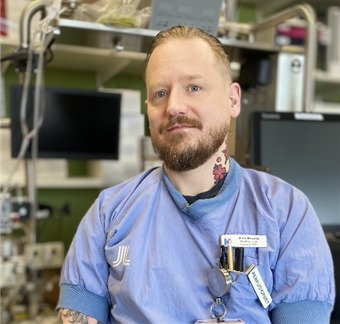
The choice of technique in thoracic aortic surgery can affect the risk of complications and treatment outcomes. On June 5, 2026, Erik Braatz will defend his doctoral thesis "Perfusion and surgical management in patients with thoracic aortic disease" in which he has investigated how thoracic aortic surgery can become even safer.
“My thesis focuses on thoracic aortic surgery performed using a heart–lung machine. As a perfusionist, I am responsible for managing this machine during cardiac surgery. My colleagues and I also work with ECMO and other types of mechanical circulatory support,” says Erik Braatz, doctoral student in the Thoracic Surgery group at the Department of Molecular Medicine and Surgery, Karolinska Institutet.
“The ascending aorta may need to be replaced urgently, for example in a life-threatening aortic dissection, or as a planned procedure for an aortic aneurysm. Different surgical techniques are used depending on the situation and extent of aortic disease. Much of my research has been made possible through large national registries such as SWEDEHEART and NORCAAD.”
Which are the most important results?
Safer femoral access in emergency aortic surgery
“In acute type A aortic dissection, inserting cannulas through the groin using a minimally invasive percutaneous technique appears to be safe. It may also lead to fewer complications such as seroma, infections, or nerve injuries compared with traditional open access.”
Differences between women and men
“In Sweden between 2016 and 2020, women undergoing surgery for disease of the proximal aorta were on average older than men at the time of surgery. Their higher age and additional health conditions, rather than sex itself, seem to explain why women had roughly twice the risk of dying within 30 days. Importantly, the overall risk remains low.”
Comparison of two surgical approaches in thoracic aortic surgery
“When the distal aorta near the first neck artery measures 40 to 50 mm, two surgical techniques can be used safely, hypothermic circulatory arrest with selective brain perfusion or aortic cross clamping. In patients operated in Stockholm between 2016 and 2024, there were no significant differences between these two methods in terms of 30-day mortality, stroke, kidney failure requiring dialysis, or long term survival.”
Less use of cooling may be enough, or even better
“My meta analysis shows that moderate hypothermia below 28°C during surgery for acute type A aortic dissection does not provide better protection against stroke, kidney injury, or early death compared with milder cooling, targeting temperatures above 28°C. With milder cooling, surgery can be performed faster and the body’s ability to clot blood is less affected after the operation.”
How can this new knowledge contribute to the improvement of people’s health?
“This research can help make thoracic aortic surgery safer and more precise, with fewer complications. Acute type A aortic dissection has long been a condition with high mortality, but the focus is now shifting toward improving outcomes through minimally invasive techniques and optimizing temperature management together with brain perfusion techniques.”
“Elective thoracic aortic surgery carries a low risk. Some operations require circulation to be temporarily stopped, while the brain continues to receive blood flow through the heart–lung machine. Even under these conditions, surgery can be performed safely, allowing complete removal of diseased parts of the aorta when needed.”
What are your future ambitions?
“I hope to continue my research through a postdoctoral position in the near future. Combining clinical work with academic research during my PhD has made me a better perfusionist. I aim to contribute to further advances in extracorporeal circulation and to expand research in this area, hopefully to benefit more groups of patients,” says Erik Braatz.
Dissertation
Friday June 5, 2026 at 09:00, Torsten Gordh, S2:02 Norrbacka, Eugeniavägen 27. The doctoral thesis has been supervised by Malin Stenman.
Thesis
Braatz, Erik (2026). Perfusion and surgical management in patients with thoracic aortic disease. Karolinska Institutet. Thesis. https://doi.org/10.69622/31495969.v1