

AI-driven robot patient can train medical students in clinical reasoning
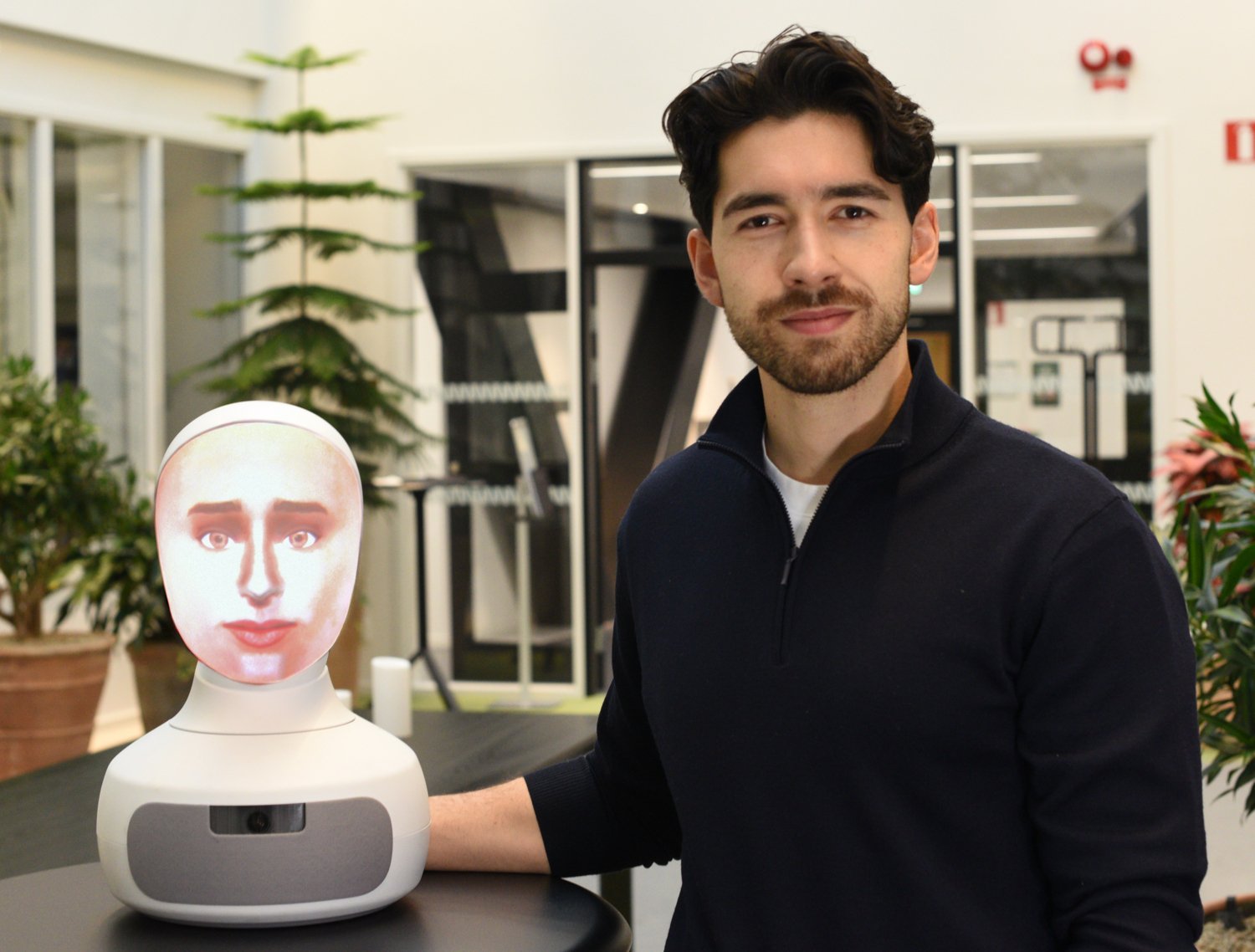
A doctoral thesis at Karolinska Institutet investigates how an AI-enhanced social robot can be used as a virtual patient to improve the clinical reasoning and communication training of medical students.
Training clinical reasoning involves gathering information, assessing a patient’s symptoms and making medical decisions. While this is an essential skill for prospective doctors, there are often few opportunities to practise it live with patients. For his doctoral thesis, Alexander Borg at the Department of Medicine in Solna, developed and evaluated a new training tool: AI-enhanced virtual patients embodied through a social robot to simulate real-time conversations with patients.
Rheumatic disorders
The modality, known as SARI (Social AI‑enhanced Robotic Interface), combines social robotics with advanced language models and can hold natural conversations, project facial expressions and provide automatic feedback on the students’ performance. The technological platform builds on earlier studies in which virtual patients were used in computer-based simulations with limited interactivity, which is considered an obstacle to clinical reasoning training.
SARI is used for practical skill training at Karolinska Institutet during term 6 of the medical programme, and is programmed to deal with patients with rheumatic conditions and disorders – a group whose symptoms can vary widely.

“Rheumatology cases can be complicated and it can take time for doctors to arrive at some kind of definitive diagnosis,” Borg says. “Dealing with such patients requires a systematic approach from many different perspectives, which makes rheumatology a particularly suitable medical discipline for this type of training.”
Changes of facial expressions
In the training room, the students engage with a plastic bust on a table, but the sensation is not that of just having a mock conversation with a dummy, since the head has an internal projector that can produce different faces and change facial expressions during the conversation.
“The medical students communicate with the robot by speaking into a microphone and making eye contact,” Borg continues. “The robot replies via a built-in speaker and its facial expressions change depending on the content of the conversation. It also keeps its gaze fixed on the student to mimic a human conversation as closely as possible.”
Responsibility and involvement
In five studies involving close to 200 medical students, Borg and collaborators compared SARI with a traditional computer-based platform. According to the results, the medical students found the social robot more authentic and engaging, and that it brought an element of realism to their studies that text-based cases lack. They also found that the robot’s presence and ability to give verbal and emotional feedback made the situation resemble genuine consultations.
“We wanted to create an environment in which students get to practise their skills in a way that isn’t so dissimilar from a real patient conversation but that’s also in a completely risk-free environment,” Borg explains.
The findings also show that AI-generated feedback from SARI resulted in quantifiable benefits to the students’ clinical reasoning and communication skills in subsequent objective assessments. The robotic patient also gave students a greater sense of responsibility and involvement than computer-based simulations.
“The technique can help give all students the same opportunities to practise, regardless of which patients happen to be available during their clinical placement,” Borg says.
Doctoral thesis
"Virtual patient simulations using artificial intelligence and social robotics to enhance clinical reasoning in medical education" The doctoral project has been supervised by Ioannis Parodis, and is scheduled to be defended on 20 February at 9.00 am at J3:06 Ulf von Euler, BioClinicum, Karolinska University Hospital, Solna.