
From brain research to real-world impact: Insights from the Neuroinnovation Summit
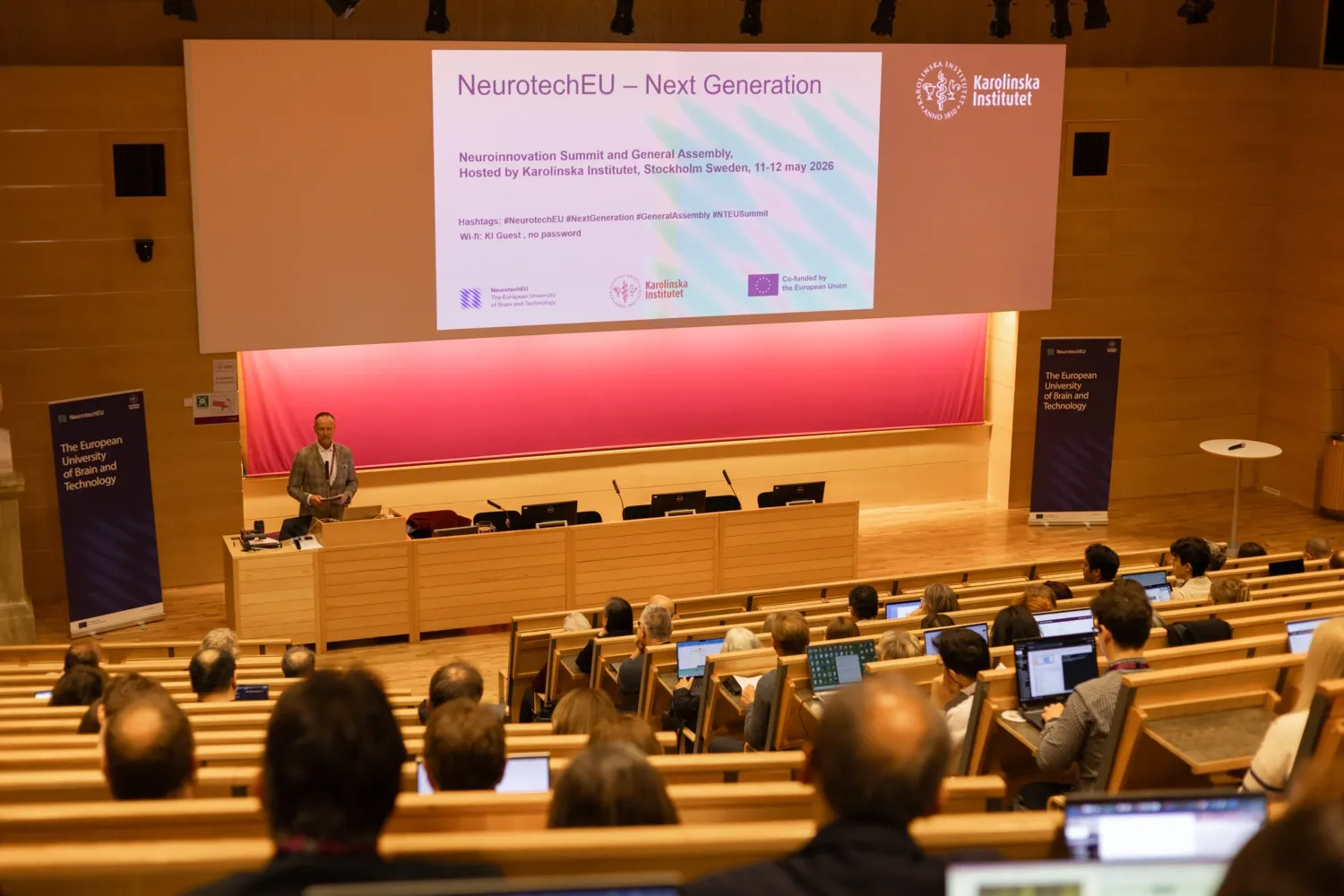
On 11–12 May 2026, Karolinska Institutet hosted the NeurotechEU Neuroinnovation Summit, bringing together researchers, clinicians, educators, and entrepreneurs from across the European University of Brain and Technology alliance to explore how neurotechnologies can move from laboratory discovery to real-world impact.
The programme spanned a wide range of topics, opening with keynote speaker Carl Sellgren's research on synaptic loss in schizophrenia. Using patient-derived cells and brain organoids, Sellgren's group demonstrated that excessive microglial pruning drives the synaptic loss that neuroimaging had previously observed in patients during early psychotic episodes.
The summit also turned a spotlight on translation and entrepreneurship. Gustaf Öqvist presented Lexplore, a KI-born startup that uses eye-tracking and machine learning to support reading development, a compelling example of research having societal impact. Bardia Bijani made the case for why doctoral researchers should engage early with commercialisation pathways, intellectual property, and venture building, while Ana Osório, Career Coordinator of the Internship Program at KI, presented a range of tools and opportunities available to early-career researchers outside the academic environment.
On the infrastructure side, Jan G. Bjaali introduced EBRAINS, an open research platform offering multi-species brain atlases and large-scale data tools — described as a kind of "Google Maps for the brain." Ásgeir Jónsson presented Blueprint, a NeurotechEU initiative embedding entrepreneurial thinking into academic training programmes. The summit concluded with a keynote lecture by Mikael Svensson, offering a historical and translational overview of neurosurgery over the last century, and concluding by pointing towards future directions, highlighting robotics, AI, and brain–machine interfaces as the next frontier in clinical precision.
The summit underscored a shared ambition across the NeurotechEU alliance: that excellent neuroscience research, paired with the right training and translational mindset, can generate meaningful impact — for patients, for society, and for the next generation of researchers.
(Article based on From Brain Research to Real-World Impact: Insights from the Neuroinnovation Summit at theneurotech.eu)