
Dr Niklas Lidströmer defends dissertation on AI-driven medical innovation
Researcher behind groundbreaking concept for patient-controlled health data defends dissertation in Copenhagen.
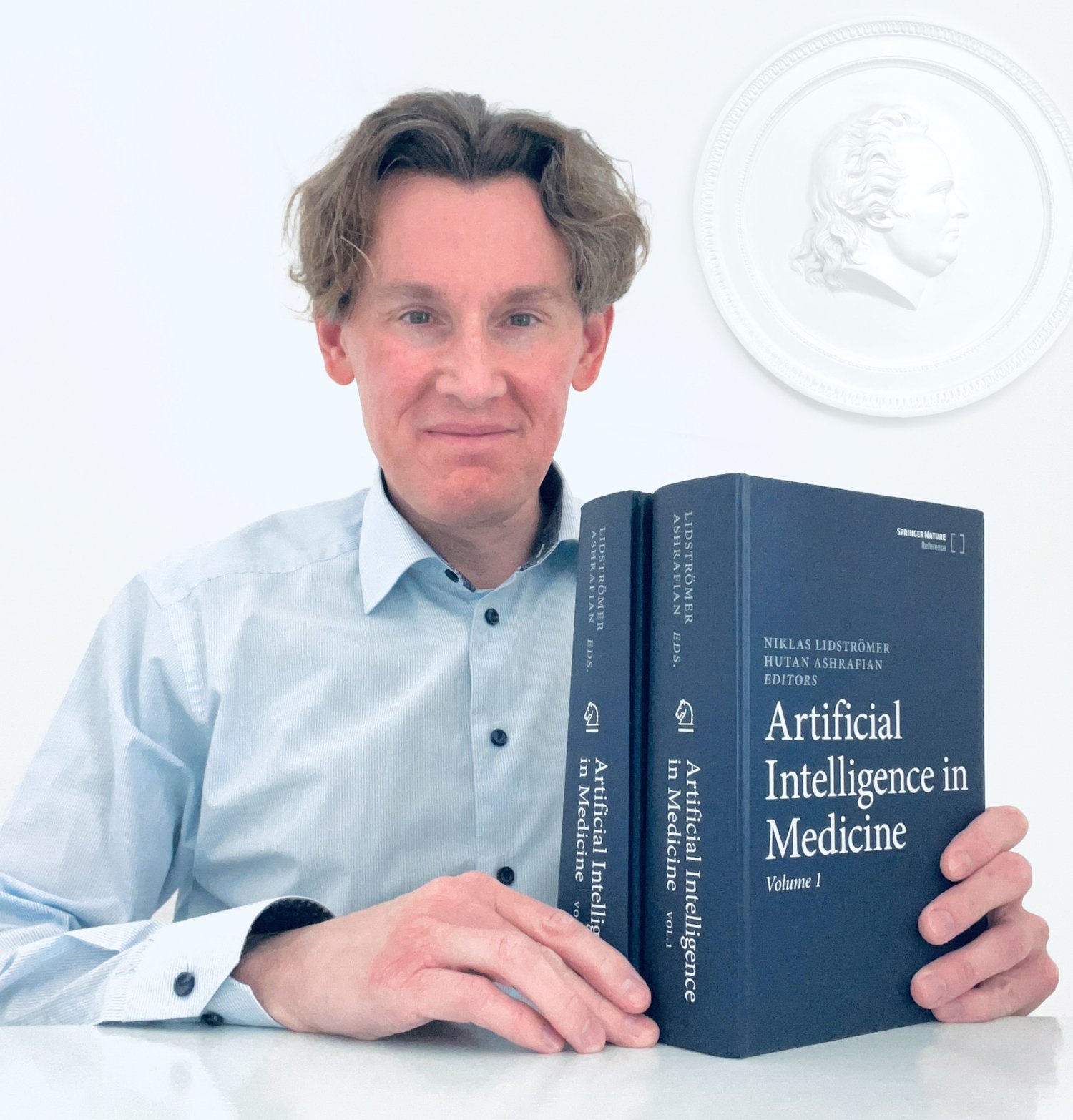
Dr Niklas Lidströmer is a physician and senior researcher with particular focus on how artificial intelligence can be integrated ethically and safely into healthcare. He has recently defended his doctoral dissertation in Copenhagen. The dissertation marks a milestone in a 16-year research project on artificial intelligence in medicine and health informatics. Throughout his career, he has worked clinically in eight countries, which has given him a broad global perspective on medicine and technology.
From Idea to Doctorate
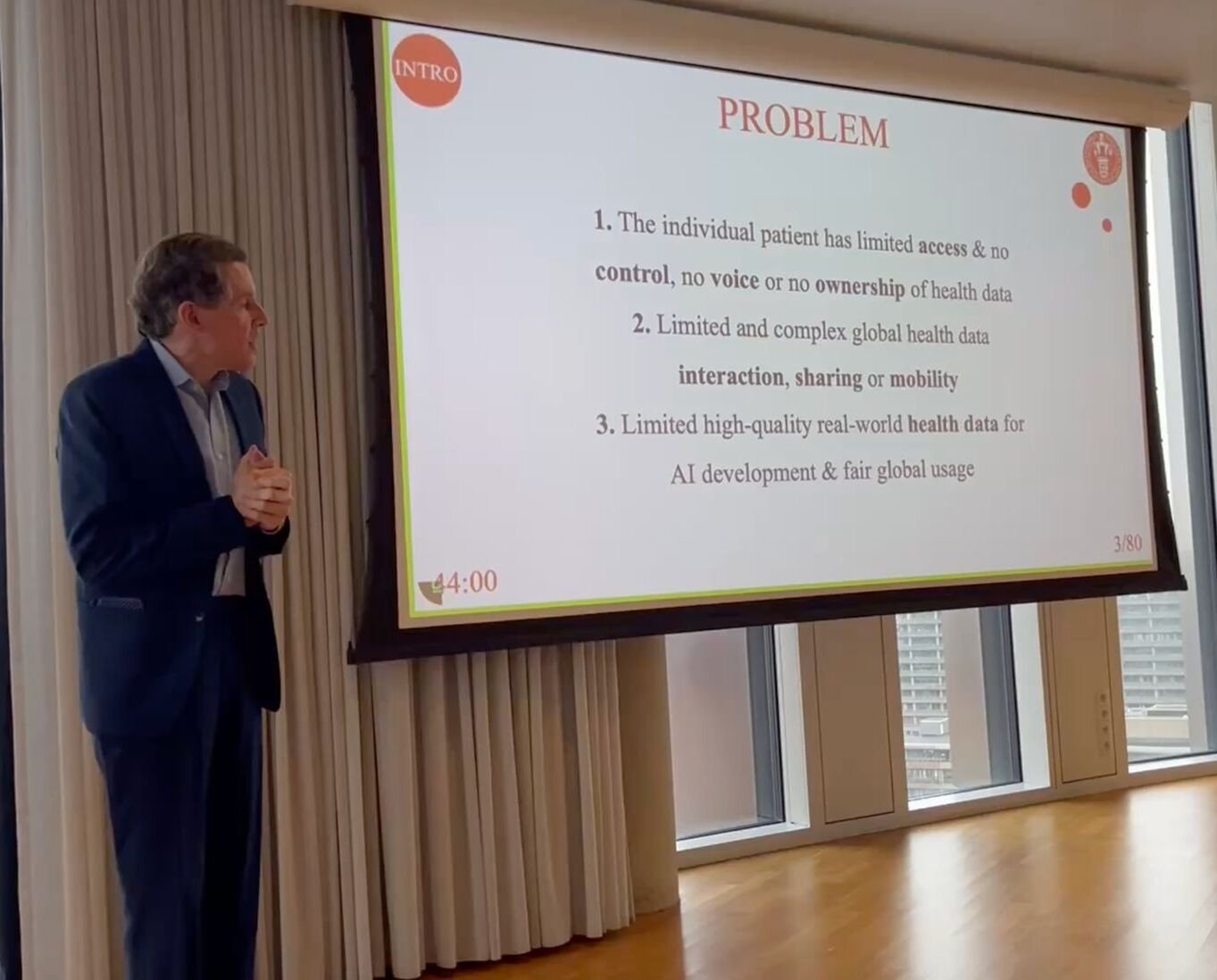
Niklas's research project is based on a concept he himself developed: Global Patient co-Owned Cloud, abbreviated as GPOC. The concept concerns creating AI-integrated global systems for patient records that are both secure and controlled by patients themselves.
"I attempted to launch this concept as early as 2010, and now, over 30 publications and three books later, the time is more mature," says Niklas.
The fundamental idea behind GPOC is that patients should be able to co-own and control their own health data whilst allowing that data to be used for medical research in an anonymous manner. The system is built on advanced technologies such as blockchain, encryption, and so-called federated learning – methods that make it possible to research large datasets without compromising security.
Complex Security System
The security solution is comprehensive and technically advanced. It is built on an intricate system of blockchain, homomorphic encryption methods, federated learning, fog computing, and edge architecture. Niklas also employs a technology called ZK-Snarks, which enables ultra-fast and secure data verification.
The research extends far beyond pure technology. It also encompasses ethical, philosophical, legal, and economic considerations regarding how such a solution should be designed and launched globally.
Democratisation of Healthcare
According to Niklas, his research fundamentally concerns "building and launching an AI-integrated medical solution that is ethically, philosophically, economically and legally correct, enabling global research on very large quantities of health data, democratising healthcare and medical science."
A central part of the vision is the ability to research large quantities of health data from around the world, which could accelerate medical research and the development of new treatments. Simultaneously, Niklas emphasises the importance of patients retaining control over their own information and that access to artificial intelligence in medicine is distributed fairly.
"It is also about contributing to enlightenment, insight, and health education," he says.
International Collaboration Going Forward
Following his dissertation defence, Niklas plans to build further on his work through continued multinational collaboration, more lectures and international seminars, and increased teaching. An important next step is to complete a finished product for the global market.
He speaks several languages and has worked as a specialist physician in Sweden, Denmark, Norway, Switzerland, the United Kingdom, Australia, France, Spain, and the Faroe Islands. This international experience has shaped his ambition to create global solutions for medicine and healthcare.
The dissertation represents, according to Niklas, "a milestone and a recognition."
"It also means," he says, "approval to continue on the professorial track – something that is entirely in line with his extensive publications and citations within the field."
With the dissertation completed, Niklas now stands on the threshold of the next chapter in his career as a researcher and innovator in medicine and artificial intelligence.
Thesis
Artificial Intelligence Powered Global Patient co-Owned Cloud (GPOC) of Personal Health Records
Read more from Dr Niklas Lidströmer
Immediately following the dissertation, his new monograph “The AI Ideal: Aidealism and the Governance of AI” is now being published by Morgan Kaufmann, Elsevier. Here, Niklas introduces new concepts and a new ideology – Aidealism.
It offers an action-oriented vision for ensuring that artificial intelligence strengthens democracy, ethics, and human dignity. Rather than allowing artificial intelligence to concentrate power in the hands of a few billionaires, the book argues for a new global framework – one in which artificial intelligence serves justice, enlightenment, and human progress.
With roots in European Enlightenment ideals, Scandinavian social models and liberalism, and Swiss direct democracy, Aidealism rejects extremist ideologies and promotes pragmatic, ethical, and forward-thinking solutions. From free education and healthcare to AI-driven economic justice and climate responsibility, the book explores how artificial intelligence can contribute to building a sustainable, free, and prosperous world.
Rather than warning of AI catastrophes, Dr Lidströmer presents an actionable vision for artificial intelligence to strengthen democracy, ethics, and human dignity.
The book contains a manifesto for practical action, including a plan for how one can utilise and use artificial intelligence for the benefit of all – not merely for a few. It delves into humanity's everyday dilemmas: our nature, our origins, our goodness and cruelty, memes, hierarchies, political structures, and how we can build a more just, peaceful, and benevolent society. Whilst the risks are real and the threats are increasing, the book illustrates how artificial intelligence can strengthen autocrats, disrupt economies, and undermine human agency – but also how artificial intelligence could become our greatest tool for wisdom, justice, and progress, if governed with foresight and courage.
Related: The Best AI Books in 2026
"As the practice of medicine has evolved, so has the torrent of data and our inability, as clinicians, to get our arms around it as we care for patients. There is an extraordinary rescue path in sight– based on the use of artificial intelligence (AI)– that will likely be the most significant transformation for healthcare in generations. Indeed, this has the potential to be the Gutenberg moment for medicine."
"In 2020, earth was struck by the fifth deadliest pandemic in recorded history. It happened at the same time as modern Artificial Intelligence (AI) systems have been impacting a wide range of areas from self-driving cars to automatic speech and language recognition and healthcare. AI has the potential to profoundly change all areas of healthcare from applications that can understand and classify clinical documentation, through automating various tasks to analysing big patient data sets, and development of algorithms for spotting tumours and other diseases, and guiding researchers in how to construct cohorts for clinical trials."