
Christofer Juhlin appointed new professor of tumour pathology
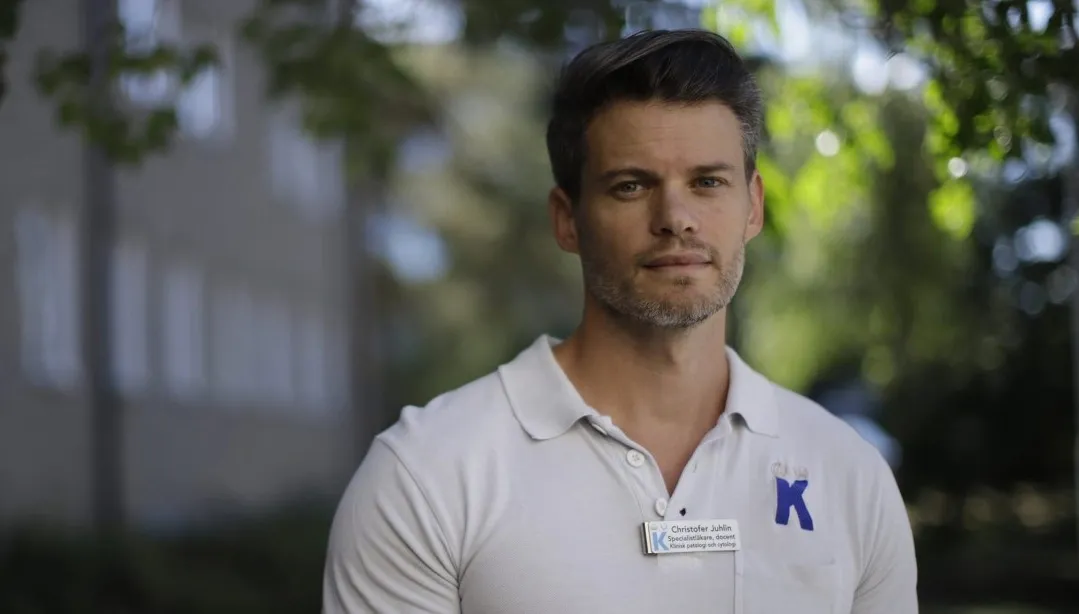
On 1 February, Christofer Juhlin took up a combined professorship in tumour pathology at the Department of Oncology-Pathology. The new position was initiated by Radiumhemmet Research Fund, who are also partially financing it. We asked Christofer a few questions about his new role and ongoing research.
Christofer Juhlin works as a senior physician in clinical pathology at Karolinska University Hospital and leads a research group in molecular endocrine pathology at the Department of Oncology-Pathology. The group maps genetic and molecular changes in hormone-producing organs, such as the thyroid, parathyroid and adrenal glands, to better understand tumour development and contribute to more accurate diagnoses and treatments.
What does the professorship mean for you and your research?
“For me, the professorship feels like a great vote of confidence. It allows me to continue building a long-term research environment where clinical pathology and molecular cancer biology meet. I have always been driven by a desire to understand why tumours behave so differently between patients, and how that knowledge can be used to make better clinical decisions.
In this role, I will have even better conditions for developing translational projects where our research results can actually influence diagnostics and treatment. It is also important for me to be able to contribute to the education of the next generation of pathologists and researchers, and to clarify the central role that pathology plays in today's precision medicine.”.
Can you describe what your research, and your research group's work, is broadly about?
“Our research focuses on understanding the molecular mechanisms that drive tumour development in hormone-producing organs, primarily in the thyroid, parathyroid and adrenal glands. We are looking for genetic changes and biological signals that can help us distinguish between tumours that are biologically indolent, meaning slow-growing and usually harmless, and those that are likely to become aggressive.
My research group works closely with clinical diagnostics. We combine classical histopathology with cutting-edge molecular technology to develop clinical markers that can be used in routine healthcare for better diagnosis, prognosis and treatment selection.”
What have you found so far?
“So far, our research has contributed to the identification of molecular changes that are now used in the clinical diagnosis of endocrine tumours. These include markers that help detect more aggressive forms of thyroid and parathyroid tumours. The work has had a clear international impact, and several of the markers that we identified early on as promising are now used in routine diagnostics at hospitals outside Sweden.
What feels most meaningful is to see how molecular findings can actually change healthcare decisions, that we can move from general treatments to more individualised ones. At the same time, we still have a lot to understand, especially about why certain tumours suddenly change their biological behaviour, and that is one of the questions we will be exploring in depth in the future.”
What is the next step?
“The next step is to continue advancing the position of pathology in precision medicine. Diagnostics is no longer just about giving a tumour the right name, but about understanding its biological drivers and likely behaviour. As our methods become increasingly high-resolution, pathologists have a unique opportunity to identify new biomarkers that can guide both prognosis assessment and treatment selection.
For precision medicine to work, pathology must be the hub where morphology, molecular biology and clinical decisions meet. Endocrine tumours range from indolent to very aggressive diseases. For the most severe forms, we need deeper mapping of the tumours’ molecular architecture to identify new therapeutic targets. I believe that pathologists are particularly well positioned to lead this work, as we are at the intersection between tumour biology and the clinical decision-making process.”