

Spatial mapping of growth plate tissue may help explain how bones grow
Researchers at the Department of Women's and Children's Health have used a novel technique to map which genes are active in different regions of the skeleton's growth plates. The findings offer new clues about how the body controls bone elongation – and why certain genetic mutations lead to skeletal disorders.
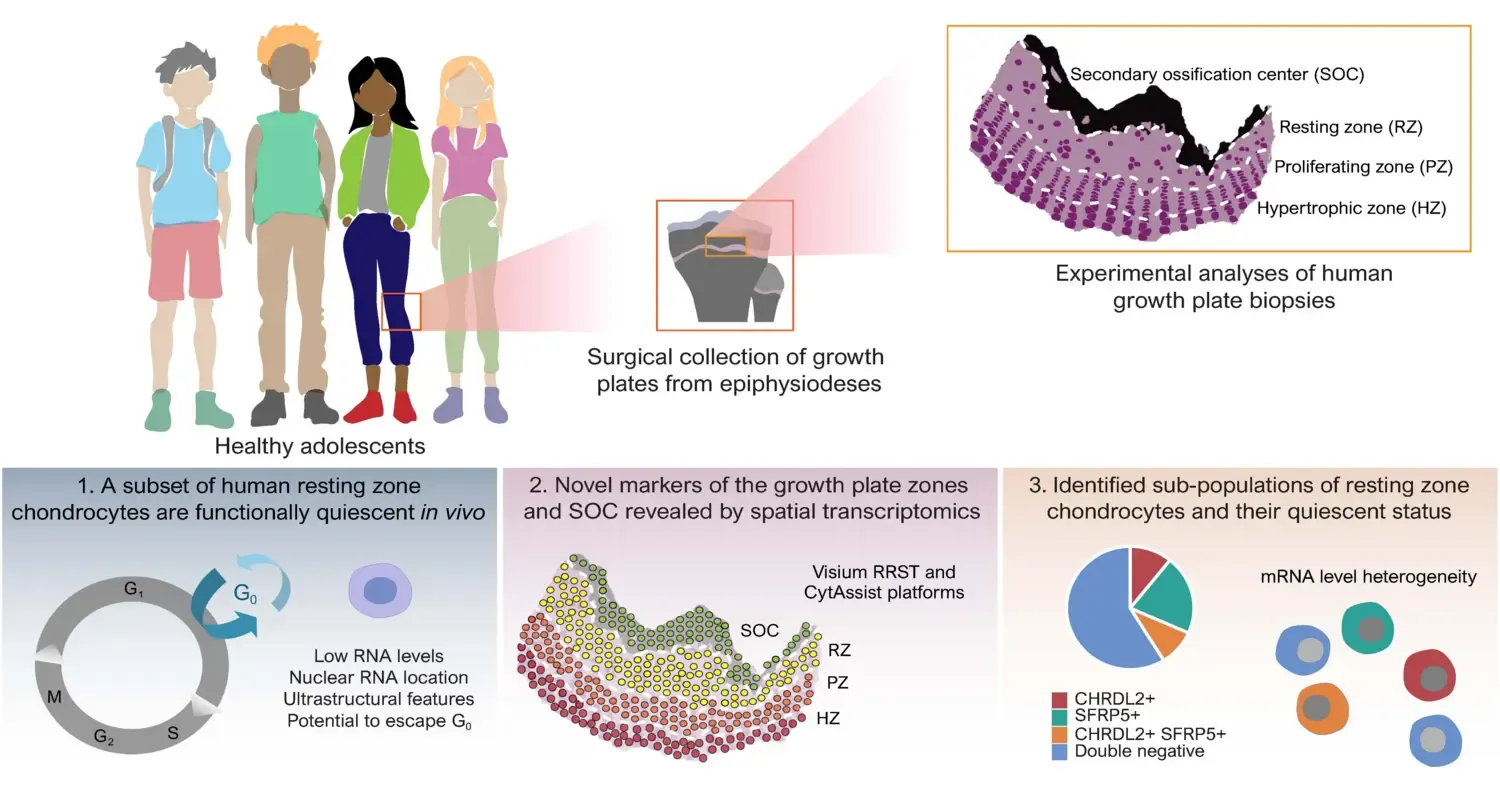
Adult height is determined by processes that take place in the skeleton's growth plates during childhood and adolescence. However, the mechanisms underlying growth maintenance remain largely unknown. In a new study, researchers analysed rare samples of human growth plate tissue using spatial transcriptomics, a method that reveals where in the tissue particular genes are switched on.
One important part of the growth plate is the so-called resting zone, which contains cells with stem cell-like properties. "These cells have often been described as "quiescent" - a kind of hibernation for cells. Our study identified new molecular and functional features of cellular quiescence in the resting zone, and that its cells differ from one another more than expected" says Phillip Newton, Docent at Department of Women's and Children's Health.
The researchers also identified both well-established and previously unreported genes active in the growth plate. One example is the gene SGMS2, which was found to be expressed in the cartilage cells responsible for mineralisation of the tissue. Mineralisation occurs within tiny structures called matrix vesicles, and the researchers showed that the protein produced by SGMS2 is present within these structures in mice. When the protein's activity was inhibited pharmacologically, mineral formation was impaired.

This may represent a new piece of the puzzle in understanding why mutations in SGMS2 in humans lead to a rickets-like disorder, in which the skeleton fails to mineralise properly.
"Confirming that known growth plate genes are active in human tissue strengthens decades of work carried out in model organisms and cell-based systems, while discovering new genes that are active may help uncover novel causes of growth disorders," says Phillip Newton.
The heterogeneity observed among cells in the resting zone suggests that the regulation of growth is more complex than previously appreciated. One open question for the future is whether growth is driven by a single type of stem cell or by a pool of equipotent progenitor cells.
"As spatial transcriptomic technologies continue to advance, we anticipate being able to map cellular states with even greater precision, providing deeper insight into how skeletal growth is regulated," says Phillip Newton.
The study was based on analyses of spatial gene expression in intact tissue achieved by collaboration between the Newton lab (including Dr. Mahtab Avijgan), Prof. Lars Sävendahl (KBH), Dr. Reza Mirzazadeh's team - including PhD student Leire Alonso Galicia (within the Lundeberg Group at KTH and SciLifeLab), and Dr. David Gomez-Cabrero´s group, including Dr. Ana López-Pérez (KAUST).