
Single iron infusion more effective for treating iron deficiency anaemia in pregnancy
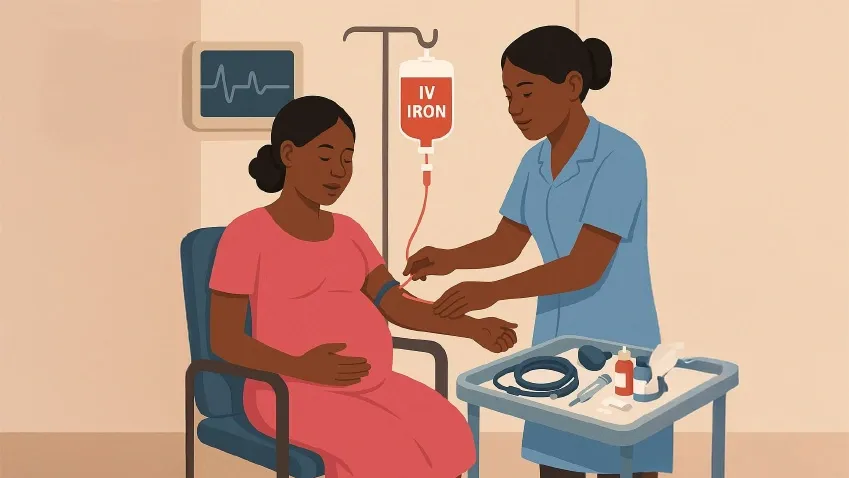
Treating pregnancy-related iron deficiency anaemia with a one-time iron infusion provides better health outcomes and greater value than standard iron tablets, according to a new study published in The Lancet Obstetrics, Gynaecology & Women’s Health. The findings may help guide healthcare decisions in low-resource settings.
Iron deficiency anaemia is a major public health concern, especially during pregnancy. Traditional oral iron tablets are widely used, but many women struggle with side effects or difficulties taking them every day, which limits how well the treatment works. In this study, researchers evaluated whether a single-dose intravenous iron treatment, ferric carboxymaltose, could offer a more cost-effective alternative.
The study analysed data from a large clinical trial involving 1,056 pregnant women aged 15–49 years, all between five and seven-and-a-half months pregnant and with haemoglobin levels below 10 g/dl. Half received iron tablets three times a day until delivery, while the other half received one iron infusion. Using these data, the research team developed a decision tree model to compare the treatments in terms of recovery from anaemia, complications such as severe bleeding after childbirth, and overall costs.
A practical and cost-effective option

“We saw that many women could not benefit fully from oral iron because of side effects or challenges remembering to take the tablets every day,” says Opeyemi Akinajo, who recently completed her doctoral studies at the Department of Global Public Health, and is currently a senior lecturer at the College of Medicine, University of Lagos, and a consultant in obstetrics and gynaecology at Lagos University Teaching Hospital. “A single-dose infusion, given once over a short period, helped restore iron levels more quickly and effectively.”
The analysis showed that the infusion led to fewer health problems related to iron deficiency anaemia and provided better value for money, even though the upfront cost was higher. According to the researchers, the findings carry strong policy relevance for countries where resources are limited.
“Our results suggest that a one-time intravenous treatment can be a practical and cost-effective option for managing iron deficiency anaemia in pregnancy, particularly in low-resource settings,” says Dr. Akinajo. “Lowering the cost of the infusion would further improve access and help more women benefit from this treatment.”
The research team now aims to explore how iron infusion can be integrated into routine antenatal care. This includes assessing strategies such as price negotiations, inclusion in health insurance schemes, and policy changes. The group is currently collaborating with the Nigerian Federal Ministry of Health to support adding the treatment to the essential medicines list.
The study was conducted in collaboration with the Institute of Tropical Medicine in Antwerp, the London School of Hygiene and Tropical Medicine, College of Medicine, University of Lagos, and Bayero University in Nigeria. It was funded by the Bill & Melinda Gates Foundation, and the researchers report no conflicts of interest.
Publication
Intravenous ferric carboxymaltose versus oral ferrous sulphate for iron deficiency anaemia in pregnancy in Nigeria: a cost-utility analysis, Opeyemi Rebecca Akinajo, Kristi Sidney Annerstedt, Maria Teresa Santos, Bosede Bukola Afolabi, Aduragbemi Banke-Thomas, The Lancet Obstetrics, Gynaecology, & Women's Health, online 28 April 2026, doi: 10.1016/S3050-5038(26)00049-X.