

Should climate change be declared a global health emergency?

This question is currently being considered by the World Health Organization (WHO) and was also the topic of a panel discussion held by the Department of Global Public Health in May.
The question of whether climate change should be classified as a Public Health Emergency of International Concern (PHEIC) is currently under discussion within the World Health Organization (WHO), following a request from the Pan-European Commission on Climate and Health.
The topic was also the focus of a panel discussion hosted by the Department of Global Public Health. WHO’s regional climate and health directors Sandro Demaio (Western Pacific) and Robb Butler (Europe) joined KI researchers Petter Ljungman and Ester Gubi to explore the potential benefits and challenges of such a declaration. The discussion was moderated by Stefan Swartling Peterson, Professor of Global Transformation for Health at Karolinska Institutet.
A framework designed for acute crises
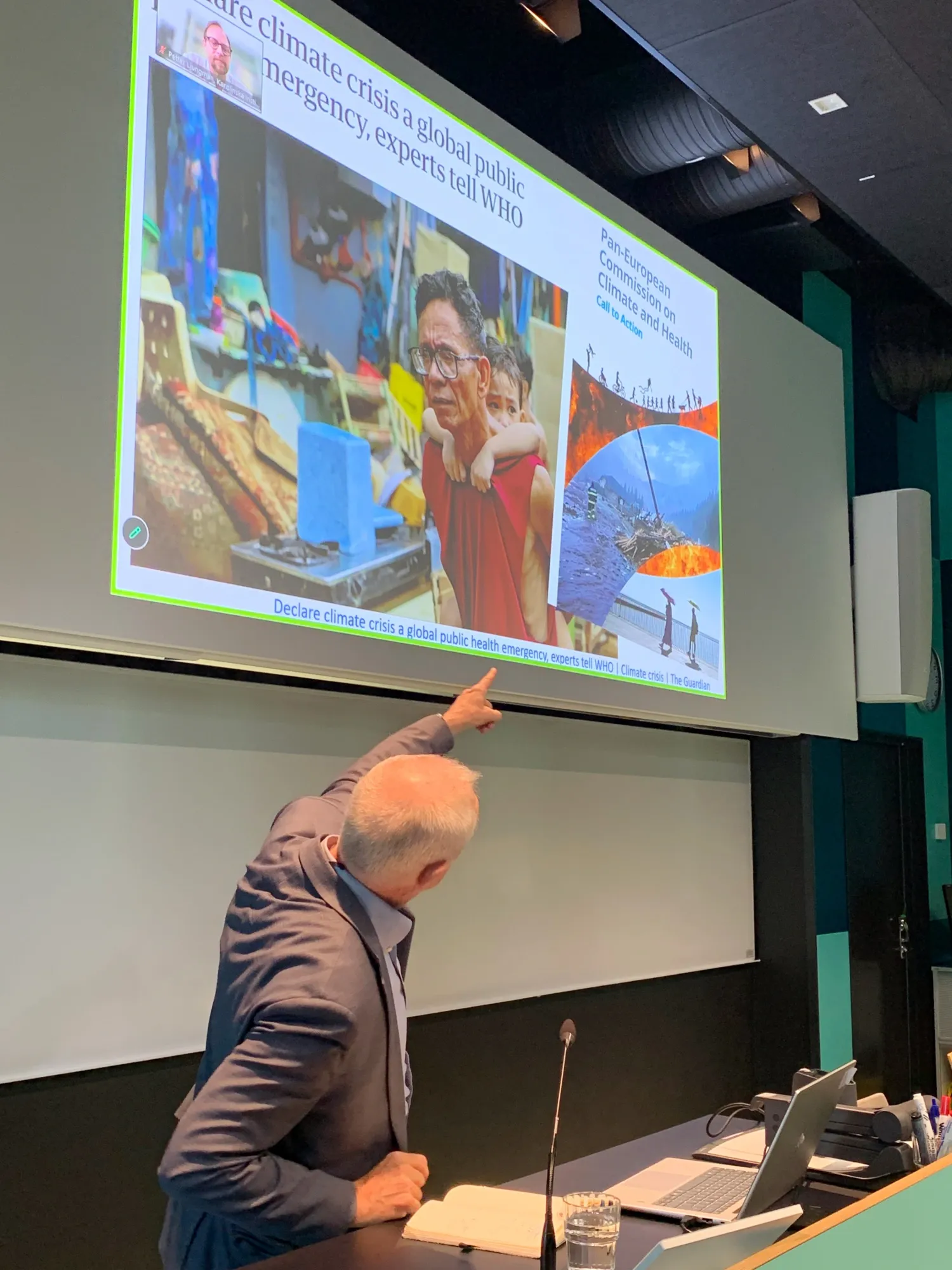
Under the International Health Regulations, a PHEIC can be declared in response to events such as disease outbreaks that are sudden, have a significant public health impact, spread internationally and require coordinated global action. The ongoing Ebola outbreak is one example of a situation that has been declared a PHEIC.
During the seminar, participants noted that climate change differs from such events. It is a long-term and slow-moving threat, which creates a conceptual mismatch with the PHEIC framework, designed for acute and time-limited crises. Comparisons were made with other gradual global health challenges, such as antimicrobial resistance.
At the same time, as it was emphasized, the health impacts of climate change are already substantial. For example, extreme heat is estimated to have caused more than 100,000 additional deaths in Europe during 2022–2023.
Increased political commitment or a diluted tool?
Speakers argued that recognizing climate change as a global health emergency could help mobilize stronger political commitment and international coordination. Others agreed with this potential impact but raised concerns that the tool risked becoming diluted and would be better reserved for events such as Ebola outbreaks. In a concluding show of hands, a majority of the audience at the seminar supported declaring climate change a Public Health Emergency of International Concern.
The discussion also highlighted the need for further research on how people and societies respond to slow-moving risks. Participants pointed to the potential to address climate change and non-communicable diseases together as a “syndemic”, linked through the food system.
--
The full set of recommendations from the Pan-European Commission on Climate and Health is summarised in the statement Climate change is a health crisis – and fixing it is a health opportunity.