

Living with cats does not appear to worsen children’s asthma in the short term
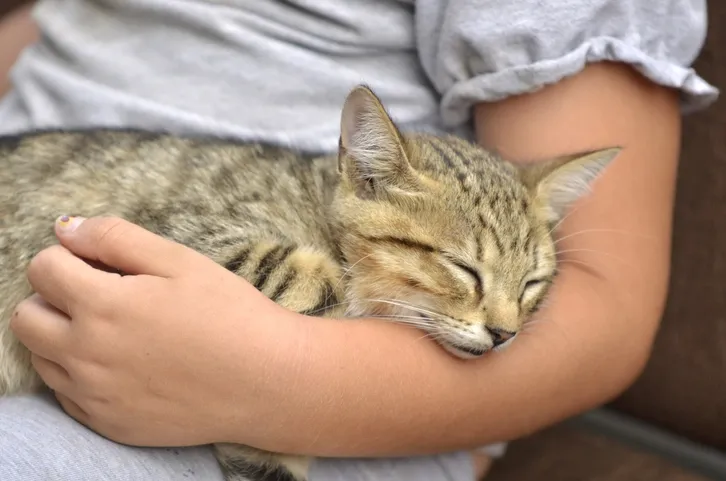
Children with asthma and allergies who live with one or more cats do not experience worse asthma outcomes than children without cats at home. This is according to a comprehensive Swedish registry study from Karolinska Institutet, published in Frontiers in Allergy.
Many families with asthmatic children are advised to avoid keeping furry pets in the home. At the same time, previous studies on how cats as pets affect children with asthma and allergies have often been small and produced conflicting results.
The new study covers over 30,000 children in Sweden aged 4–17 with diagnosed asthma and allergies. The researchers followed the children for two years, comparing those living in households with cats with those who did not. Data on cat ownership was obtained from the national cat register and combined with data from several Swedish health and quality registers.

“We found no evidence that living with cats worsens asthma in children who already have asthma and allergies,” says Resthie R. Putri, postdoctoral researcher at the Department of Medical Epidemiology and Biostatistics, Karolinska Institutet. “Unfortunately, however, we had no information on the specific allergies the children had, so we do not know whether they were allergic to cats or not.”
Individual advice is needed
The researchers analysed asthma exacerbations leading to emergency care, asthma severity based on medication use, asthma control, and lung function in the children. Children living with one or more cats experienced similar asthma outcomes to those without a cat. Nor could the number of cats in the home, or the age or sex of the cat, be linked to differences in asthma outcomes.
One strength of the study is the large number of participants from across Sweden. However, differences between countries may limit the applicability of the results to other contexts. As the Cat Register is relatively new, some cat exposure may not have been captured in the study. Furthermore, there was no information on how long the children had been exposed to cats for, or how much time the cats spent indoors. The researchers also cannot rule out the possibility that families with children suffering from more severe allergies may have chosen not to keep a cat.

“Clinical advice always needs to be tailored to the individual, and our study can contribute to the evidence base in discussions with families about pets and asthma,” says Catarina Almqvist Malmros, professor at the Department of Medical Epidemiology and Biostatistics, Karolinska Institutet, and paediatrician at Astrid Lindgren Children’s Hospital.
Will continue to follow the children
The researchers now plan to continue studying how different types of allergies may affect the outcome, and whether it makes a difference if the child is allergic to cats. They also plan to follow the children for a longer period to see how cat ownership may affect asthma over time.
The research was funded by the Swedish Research Council, the Swedish Heart-Lung Foundation, the Swedish Asthma and Allergy Association’s research fund, Region Stockholm (ALF funding), the Frimurare Barnhuset Foundation in Stockholm and the Jerring Foundation. One of the co-authors has received fees and non-financial support from companies unrelated to the current study. The other researchers report no conflicts of interest.
Publication
“Cat exposure and asthma outcomes in a cohort of children with asthma and allergy”, Resthie R Putri, Cecilia Lundholm, Anna Hedman, Mwenya Mubanga, Hanna Karim, Jon Konradsen, Catarina Almqvist, Frontiers in Allergy, online 10 June 2026, doi: 10.3389/falgy.2026.1840756.