
Increasing cancer incidence trends among young adults
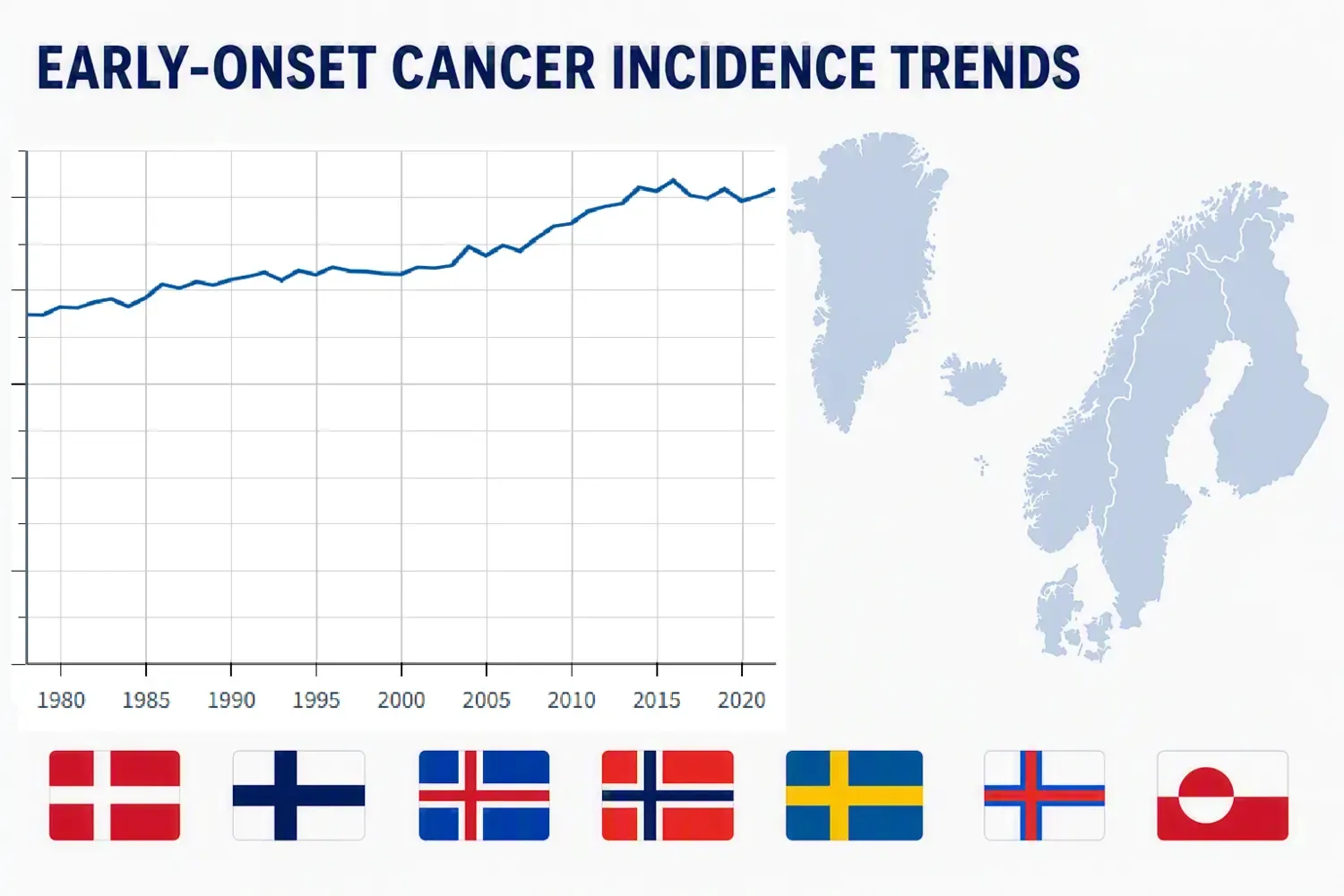
Cancer incidence rates have increased for 12 out of 18 cancer sites in young adults below 50 years during the last 20 years. This is shown in a new study published in the Lancet Regional Health – Europe in which researchers including scientists from Karolinska Institutet analysed cancer registry data from over 2.2 million cancer cases in the Nordic countries. These findings contribute to a better understanding of the increasing cancer burden in the young.
Cancer among young adults below age 50 years, so-called early-onset cancer, is rare. Yet increasing trends of early-onset cancer have been reported in many countries. In this new study, researchers describe recent incidence trends for 18 common cancers in seven Nordic countries covering a population of nearly 28 million individuals.
The researchers found that the early-onset cancer rates have increased for 12 out of 18 cancer sites between 2003 and 2022. The largest increases occurred for thyroid, colon and kidney cancer with over 2.5 per cent per year. Increases over 1 per cent per year were also found for rectal, prostate and liver cancers as well as for skin melanoma and multiple myeloma. In contrast, the trends decreased for two cancer sites, lung and ovarian cancer.
Different underlying reasons for increasing trends
“Our findings show a persistent pattern of increasing cancer incidence rates among young adults. Although the cancer risk among young individuals is very low in comparison to the older population, these increases are a concern since the reasons behind these patterns remain poorly understood,” says Anna Johansson, cancer epidemiologist and docent at the Department of Medical Epidemiology and Biostatistics, Karolinska Institutet. “We also know that the rates of some cancer types, such as thyroid and kidney cancer, are affected by an increased use of novel and sensitive detection techniques. However, for other cancers such as colon and breast cancer, we found the sharpest increases among young adults below 35 years, and also higher rates in the most recent generations. This is particularly concerning as these generations will likely carry their higher cancer risk forward to older ages.”
By combining data from all Nordic countries, including Sweden, Denmark, Finland, Iceland, Norway, the Faroe Islands and Greenland, the researchers were also able to study rarer cancer sites. Patterns were mostly consistent across the Nordic region, a region with high-quality cancer registration and nationally harmonized data in the NORDCAN database. All the Nordic countries also have tax-funded universal healthcare.
“As our data are observational with no individual-level information on risk factor exposures, we can only speculate around the underlying reasons for these patterns. Increasing levels of obesity have been suggested as a possible contributing factor, yet several risk factors are likely involved and will differ by tumour site. We found decreasing rates of early-onset lung cancer, which is in line with the decreasing smoking patterns in younger generations. Similarly, we found decreasing rates of skin melanoma in the most recent decade since 2013, also consistent with lower sun exposure in the younger population. These findings are hopeful, as they point towards opportunities for prevention”, says Anna Johansson.
The next step in the research project
In this Nordic collaboration between researchers at Karolinska Institutet, the Association of the Nordic Cancer Registries (ANCR) and the International Agency for Research on Cancer (IARC), future studies will include more detailed studies on the burden of early-onset cancer. Of special interest is to identify groups with particularly high risk of early-onset cancer in order to inform prevention strategies. The research was funded by the Swedish Cancer Society and the Swedish Research Council. See the study for any reported conflicts of interest.
Publication
”Trends in early-onset cancer incidence rates in the Nordic countries (2003–2022): a population-based study”, Johansson ALV, Kønig SM, Cardoso R, Møller H, Ursin G, Skog A, Persson Å, Birgisson H, Kristjánsdóttir L, Tanskanen T, Dahl-Olsen ED, Bray F, Friis S, Lambe M, Lancet Regional Health – Europe, online 12 September 2026, doi: 10.1016/j.lanepe.2026.101858.