

Lectures and seminars StratNeuro-NeurotechEU Seminar: "Advances in Neurotechnology: Bridging Brain, Data, and Machines"
Join us for this interdisciplinary seminar and register to explore the future of neurotechnology with leading experts from across Europe!
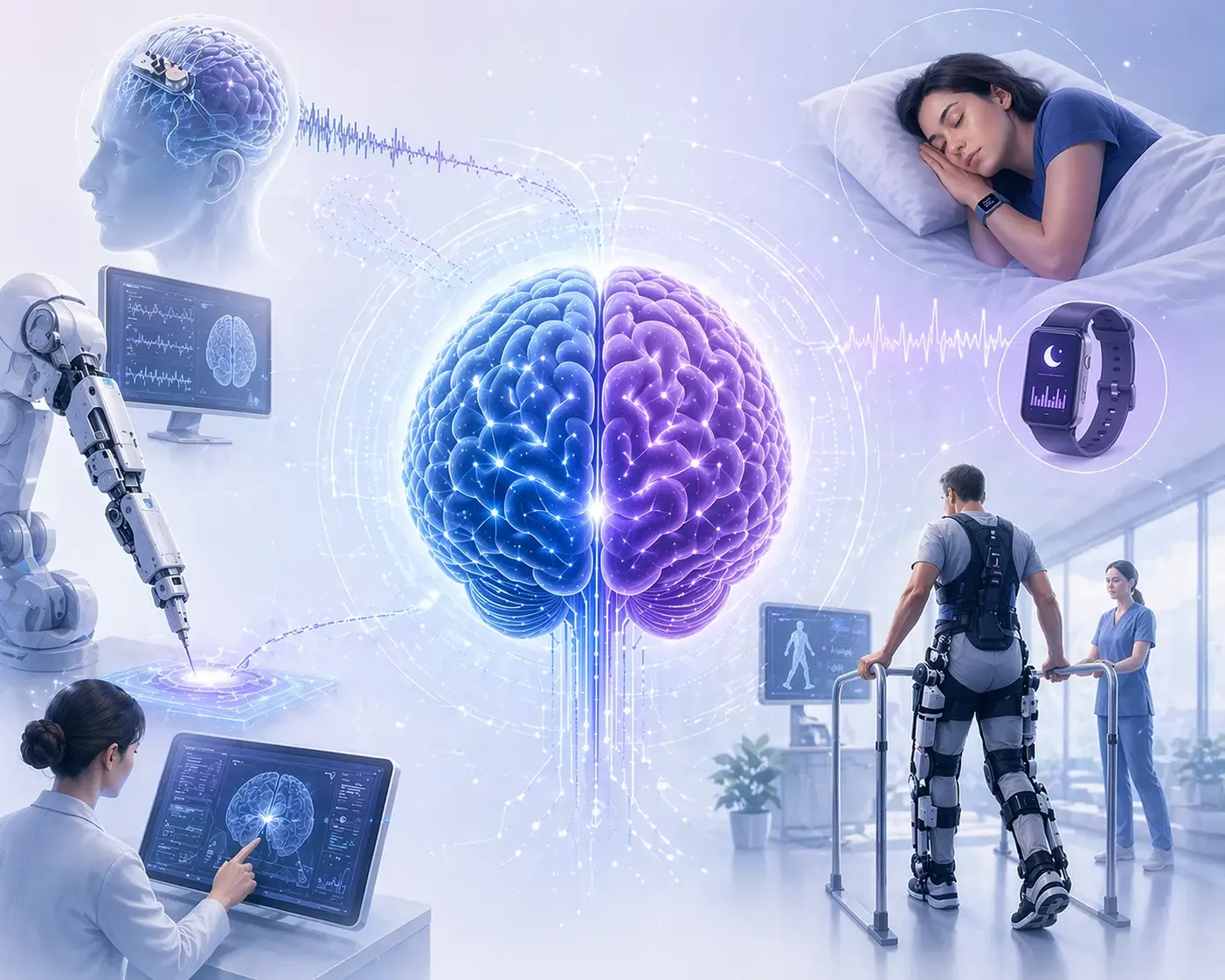
Neurotechnology is rapidly changing how we understand, measure, and interact with the brain. This seminar brings together researchers from NeurotechEU working on some of the most exciting developments in the field—from brain–machine interfaces and rehabilitation robotics to wearable sleep technologies, artificial neurons, and soft robots for medical use. The talks highlight how combining neuroscience, engineering, and AI is opening new possibilities to restore function, improve diagnosis, and build smarter, more human-centered healthcare technologies.
Programme:
13:00 – 13:30 - Neurorehabilitation Based on Brain–Machine Interfaces and Exoskeletons
José M. Azorín (Miguel Hernández University of Elche, Spain)
Abstract:
Brain–machine interfaces (BMIs) allow direct communication between the brain and external devices such as robotic exoskeletons. In rehabilitation, patients can use mental strategies like motor imagery—imagining a movement without performing it—to control these devices. This process can help stimulate the brain and support recovery of motor function. This talk will present BMI systems developed at the Universidad Miguel Hernández de Elche for controlling lower-limb exoskeletons and discuss their potential in neurorehabilitation.
Bio:
José M. Azorín is a Full Professor at Miguel Hernández University of Elche (Spain) and the Director of the Brain–Machine Interface Systems Lab. He leads the European affiliate of the NSF-funded BRAIN Center. His research focuses on brain–machine interfaces, neurorobotics, and rehabilitation robotics. He has led more than 30 research projects, published over 300 papers, and holds several patents. He is a Distinguished Lecturer of the IEEE Systems Council and President of AITADIS.
13:30 – 14:00 - Unravelling the Importance of Novel Data for the Future of Sleep Measurements
Anna Sigríður Íslind (Reykjavík University, Iceland)

Abstract:
Sleep is still mainly measured using polysomnography, which is complex and difficult to scale. This talk explores how new data sources—such as wearables, mobile apps, and patient-reported data—can improve how we study sleep. Based on the EU-funded Sleep Revolution project, the talk presents results from large clinical studies across Europe that combine different types of data over several months. These approaches can lead to more realistic and personalized sleep assessment.
Bio:
Anna Sigríður Íslind is the Professor of Computer Science at Reykjavík University and Director of the Center for Information Systems and Data Science Research. Her work focuses on digital health and AI in healthcare. She has published over 120 papers and was co-PI of the €15M Horizon 2020 Sleep Revolution project, where she led the digitalisation efforts.
----- Coffee Break -----
14:30 – 15:00 - Rewiring the Brain: How to Make Living Neurons Team Up with Hardware-Based Artificial Neurons
Christel Vanbesien (University of Lille, France)
Abstract:
This talk looks at how to connect living neurons with artificial ones in closed-loop systems. Such systems are key for future neuroprostheses that can both read from and stimulate the nervous system. The presentation will highlight a highly energy-efficient artificial neuron developed in Lille using CMOS technology, and discuss how these systems could help restore or enhance brain function.
Bio:
Christel Vanbesien is a Full Professor of Neurosciences at the University of Lille and a researcher at CNRS - IEMN (CSAM team), working at the interface of neuroscience and microelectronics. Her research focuses on artificial neurons and hybrid systems that connect biological and electronic components for neuroprosthetic applications.
15:00 – 15:30 - Gentle Precision: Robotizing Neurotech
Jérémie Dequidt (University of Lille / Inria, France)
Abstract:
Working with the brain requires tools that are both precise and gentle. This talk shows how soft and flexible robots can improve neurotechnologies, making procedures safer and more effective. It will cover key challenges in handling delicate neural structures and present new solutions based on soft robotics and real-time simulation.
Bio:
Jérémie Dequidt is a Full Professor at the University of Lille and a researcher at Inria (DEFROST team). His work focuses on soft robotics, simulation, and medical applications. He co-developed the SOFA simulation framework and works on robotic systems for minimally invasive procedures and medical training.
----- Coffee Break -----
16:00 - 16:30 Session with students