

New thesis provides insights into protein formation in Alzheimer's and Parkinson's disease
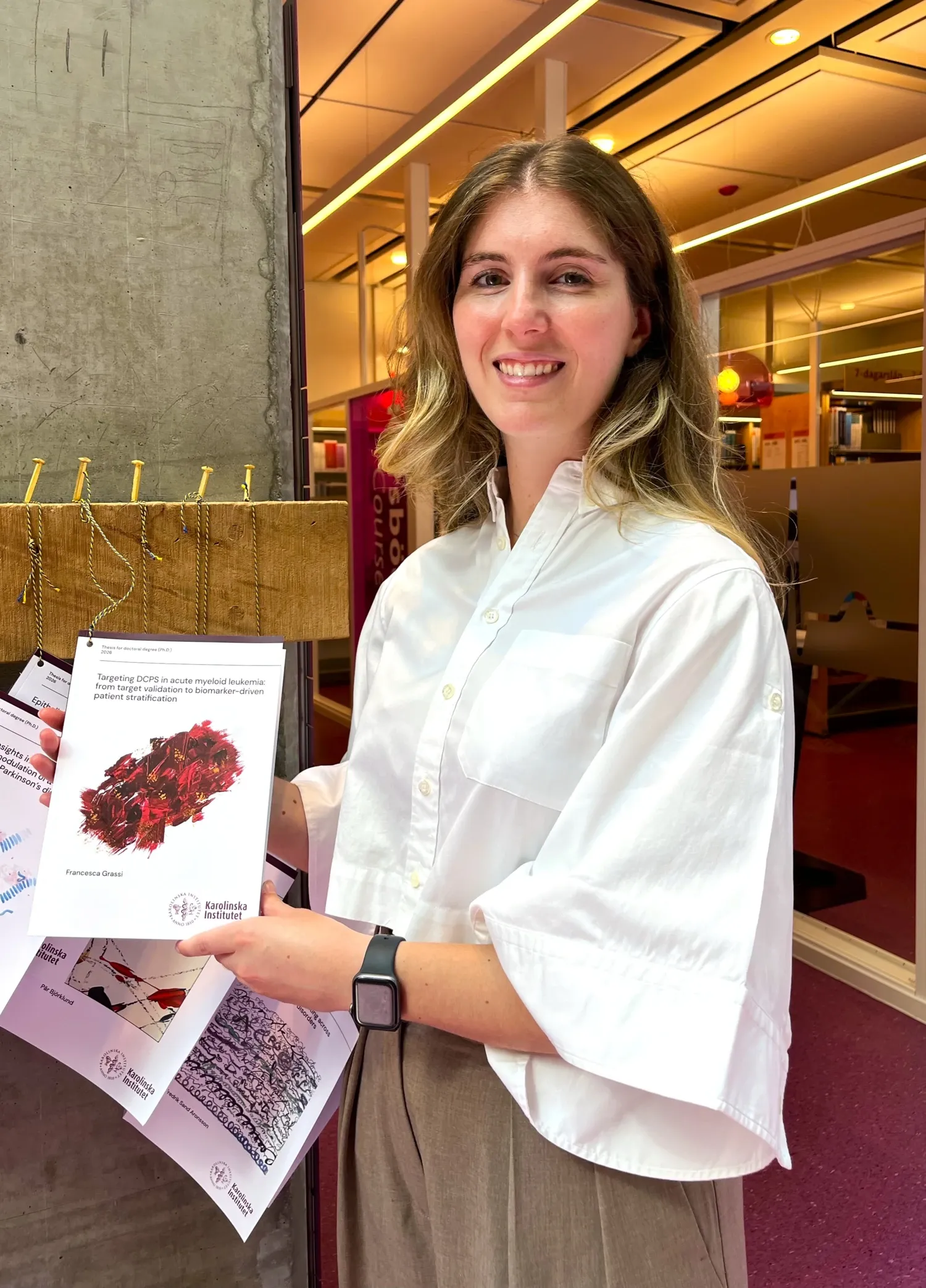
Francesca Grassi from Center for Hematology and Regenerative Medicine (HERM) at the Department of Medicine, Huddinge (MedH) is defending her thesis titled: "Targeting DCPS in acute myeloid leukemia : from target validation to biomarker-driven patient stratification", on 2 September 2026. Main supervisor is Julian Walfridsson.
What is the main focus of your thesis?
My thesis builds an innovative drug development program for the treatment of acute myeloid leukemia (AML), an aggressive blood cancer. We investigated a protein called DCPS, which is involved in mRNA metabolism, and tested a small molecule drug that blocks it, called RG3039.
We identified a biomarker, the protein FHIT, that can predict which patients will respond to a DCPS-targeted treatment. Finally, we proposed a strategy to translate these findings from the lab into successful clinical trials.
Which are the most important results?
The key finding is that low expression of FHIT predicts high sensitivity to DCPS inhibition in both cell lines and zebrafish animal models of AML. Mechanistically, when FHIT is expressed at high levels, it counteracts the therapeutic effects of RG3039 and maintains the cancer cells. We conclude that FHIT expression can be used to select patients that would benefit from a DCPS-targeted therapy.
We next addressed how these patients could be identified in clinical practice. We found that mutation status of a gene called IDH2, already tested routinely in all new AML patients, can also indicate which patients are likely to have low FHIT levels and therefore respond well to treatment. This means an existing diagnostic test could be used to help select patients to include in clinical trials testing a DCPS-targeted therapy.
How can this new knowledge contribute to the improvement of people’s health?
Currently, fewer than 3% of oncology drug development programs reach the market, often due to unexpected drug toxicity and poor selection of patients likely to benefit.
My doctoral project addresses these limitations early, before the drug is tested in patients, by proposing a DCPS-targeted therapy that uses validated biomarkers to select patients who will respond to treatment. This approach also simplifies clinical trial design, increasing the probability of success.
What are your future ambitions?
This doctoral project was funded by the Swedish Foundation for Strategic Research (SSF), as a collaboration between Karolinska Institutet and Sprint Bioscience AB. Through it, I have experienced both academic and industrial approaches to research and innovation, and I am particularly interested in continuing to develop my industrial experience in oncology at Sprint Bioscience AB.
Dissertation
Wednesday 2 September, 09:30, Gene, Neo, Blickagången 16, Flemingsberg