

An important step toward understanding how brain immune cells can slow aggressive brain cancer
Researchers at Karolinska Institutet have identified an epigenetic mechanism that allows the brain’s own immune cells to counteract glioblastoma, the most aggressive form of brain cancer. By reducing the activity of a specific enzyme in these immune cells, tumour growth was slowed in animal models.
Glioblastoma is one of the most difficult cancers to treat. The tumour grows rapidly, infiltrates surrounding brain tissue, and responds poorly to current therapies. An important reason is the tumour’s ability to manipulate its microenvironment – including the brain’s resident immune cells, known as microglia, which normally protect the nervous system.
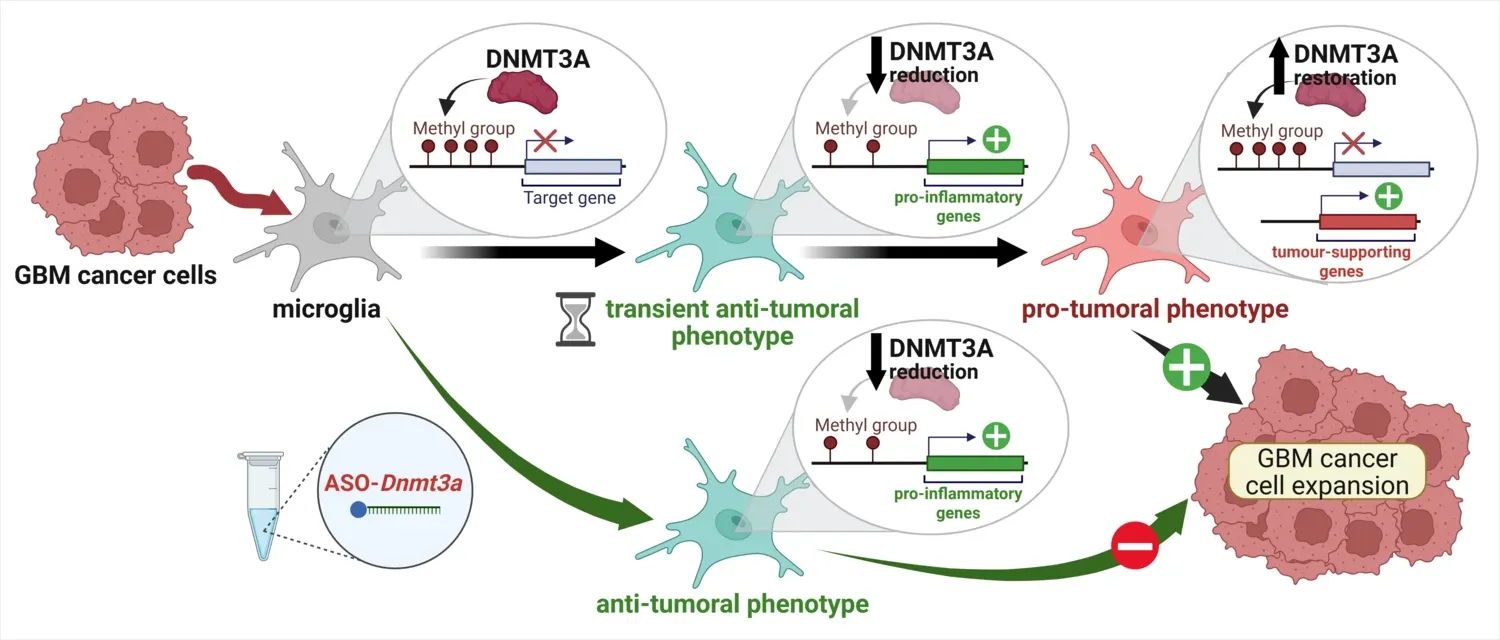
In the new study, the researchers show that microglia are initially activated into a defensive, anti-tumour state when they encounter glioma cells. During this short window, the cells display properties that can restrain tumour growth. However, this state is transient: over time, the tumour reprograms microglia into a phenotype that instead supports cancer progression.
The researchers identified a key molecular switch behind this transition: the enzyme DNMT3A, which regulates DNA methylation and gene activity in cells.

"When DNMT3A levels are reduced in microglia, genes involved in immune and inflammatory responses are activated. This gives the cells an anti-tumour behavior", says Mathilde Cheray, lead researcher of the study and researcher at the Institute of Environmental Medicine.
Tumour growth reduced by targeting DNMT3A
In collaboration with IONIS Pharmaceuticals, using antisense technology to reduce DNMT3A levels in microglia, the researchers observed several effects:
- microglia became more active and mobile
- the ability of tumour cells to migrate was diminished
- tumour growth was significantly reduced in mouse models
The findings suggest that it may be possible to reprogram microglia towards an anti-tumour state, rather than attempting to eliminate them altogether – a strategy that has shown limited success in previous studies.
A new therapeutic angle – but still at an early stage
The study is based on fundamental research using cell cultures and animal models. The researchers stress that the findings do not represent a new treatment for patients at this stage, but they do point to a previously unexplored therapeutic target.

"Our results show that microglia have an inherent capacity to counteract tumour growth. The challenge is to preserve or enhance that function. DNMT3A now emerges as a potential key regulator", say Bertrand Joseph, senior author and professor of molecular cancer biology at the Institute of Environmental Medicine.
The discovery opens up new avenues for future research, where the brain’s own immune cells could become an active part of glioblastoma treatment through more precise and cell-targeted strategies.
This work has been supported by the Swedish Research Council and the Swedish Brain Foundation, the Cancer Research Funds of Radiumhemmet, the Strategic Research Programme in Cancer, the Strategic Research Programme in Neuroscience, the InnoHK initiative of the Innovation and Technology Commission of the Hong Kong Special Administrative Region Government, the Swedish Cancer Society, the Swedish Childhood Cancer Foundation, the Karolinska Institutet Foundation, the Åke Wibergs Stiftelse, the Hedlunds Foundation, the Wallström Foundation, and the Swedish governmental grants for researchers working in healthcare. See the study for any reported conflicts of interest.
Publication
"Glioma-induced DNMT3A reduction in microglia promotes an anti-tumoral phenotype", Cheray, M., Posada-Pérez, M., Fragkopoulou, A. et al. Cell Death & Differentiation, online 18 March 2026, doi: 10.1038/s41418-026-01712-x.