

Molecular movie reveals how critical mitochondrial enzyme processes RNA

High-resolution structures explain the mechanism of human PNPase and provide insights into mutations causing hereditary hearing loss and neurological disease.
Researchers at the Department of Cell and Molecular Biology, Karolinska Institutet have captured the first detailed molecular snapshots of human polynucleotide phosphorylase (hPNPase) in action, revealing how this essential mitochondrial enzyme degrades RNA through an elegant base-flipping mechanism.
The findings, published in Nucleic Acids Research, provide unprecedented atomic-level detail of the enzyme's catalytic cycle and explain how mutations in this protein lead to severe inherited diseases.
A two-step molecular choreography
Using single-particle cryo-electron microscopy, the research team captured hPNPase in three distinct functional states, essentially creating a molecular movie of RNA degradation at near-atomic resolution. The structures reveal that the enzyme employs a sophisticated two-step mechanism to ensure precise RNA processing.
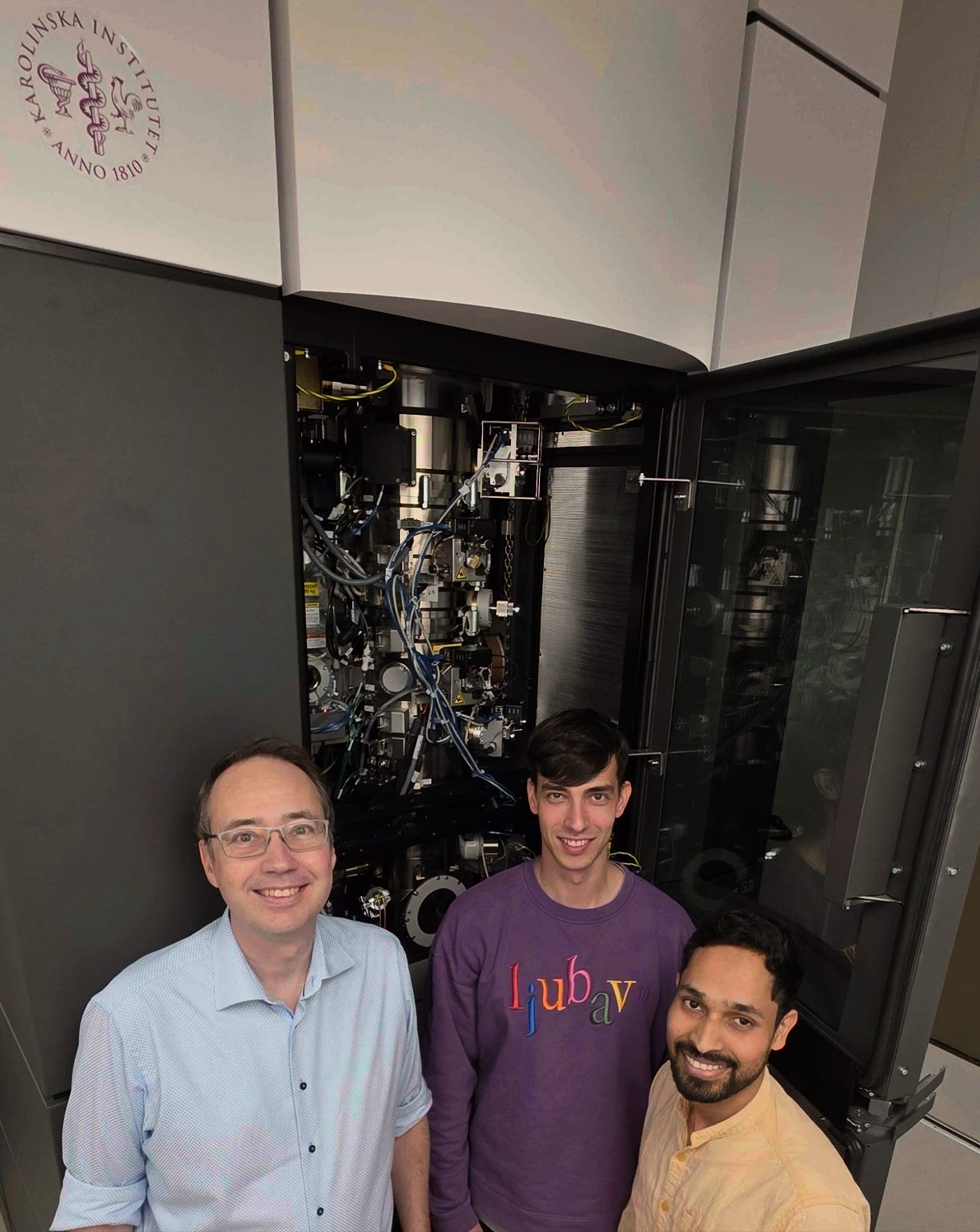
"We were surprised to discover that the enzyme uses base flipping, essentially rotating the terminal nucleotides by 180 degrees, to control where and when it cuts RNA," says first author Ole Unseld, PhD student, researcher at the Department of Cell and Molecular Biology, KI. "In the initial loading state, the RNA adopts a U-shaped conformation that recognizes the RNA correctly and prevents premature cleavage. Only after the terminal bases flip does the scissile phosphate bond move into position for catalysis."
The structures reveal that a magnesium ion plays a dual catalytic role, first positioning the attacking phosphate molecule and then stabilizing the reaction transition state. This level of mechanistic detail has not been achieved for any eukaryotic polynucleotide phosphorylase until now.
Capturing transient states
To capture different stages of the catalytic cycle, the researchers used strategic biochemical approaches. For the loading state, they employed RNA substrates containing phosphorothioate modifications that slow but do not abolish cleavage. For the pre-catalytic state, they replaced phosphate with sulfate, which binds in the active site but cannot support catalysis.
"This project required carefully stabilizing intermediate states of the reaction so that we could see discrete steps rather than an average," notes second author Hrishikesh Das, research specialist at the same department. "Integrating cryo-EM with biochemistry was key to assigning the roles of Mg²⁺-ion and Pi and describing the sequence of conformational changes during RNA binding and catalysis."
RNA mass spectrometry experiments complemented the biochemical and structural work, revealing that hPNPase predominantly releases dinucleotide products from the RNA 3´-end, with trinucleotides representing the minimal product length. This processivity pattern differs from bacterial enzymes and reflects the structural constraints of the human enzyme's active site.
Unexpected path of RNA entry
The research overturned a long-standing assumption about how RNA accesses the enzyme's active site. Unlike bacterial PNPases, in which RNA threads through a central pore, the human enzyme's pore is blocked by flexible protein loops. Instead, the structures show that single-stranded RNA enters the trimeric assembly from its bottom.
"This was completely unexpected," explains Principal Researcher Martin Hällberg, at the Department of Cell and Molecular Biology, KI, who led the research. "The flexible loops that occlude the pore don't just block RNA entry, they actively regulate enzyme activity by stabilizing the active site when RNA is bound. This represents a eukaryotic adaptation not seen in simpler organisms."
The team's biochemical experiments confirmed the structural findings, demonstrating that the enzyme requires both phosphate and magnesium ions for activity and that sulfate can block catalysis by occupying the phosphate-binding site without supporting the chemical reaction.
Structural differences from bacterial enzymes
Detailed comparison with bacterial polynucleotide phosphorylases revealed key structural adaptations in the human enzyme. The active site contains an amino acid insertion not present in prokaryotes, and the alpha-helical domain is repositioned closer to the RNA substrate. These changes create a bent RNA conformation stabilized by additional protein-RNA contacts.
These structural distinctions explain several unique properties of human PNPase: its ability to efficiently process oxidatively damaged RNA containing 8-oxoguanosine, its production of oligonucleotide rather than mononucleotide products, and its reduced polyadenylation activity compared to bacterial versions. The adaptations likely reflect the oxidative environment of mitochondria and the specialized quality control requirements of eukaryotic cells.
Why it matters
While this study focused on fundamental enzyme mechanisms, the findings have direct relevance for understanding human disease. Mutations in the PNPT1 gene, which encodes hPNPase, cause Leigh syndrome (a severe, progressive neurological disorder), hereditary hearing loss, and respiratory chain deficiencies. These conditions arise because hPNPase is essential for maintaining mitochondrial RNA quality control. When the enzyme malfunctions, aberrant RNA molecules accumulate, disrupting cellular energy production.
The research provides a molecular framework for genetic counseling. Mutations affecting the active site residues identified in this study, such as the magnesium-coordinating aspartates or the RNA-binding arginines, are particularly likely to be pathogenic. Conversely, mutations in surface regions distant from functional sites may be benign variants. This structure-function map improves the interpretation of genetic test results for affected families.
"Understanding exactly how this enzyme works at the atomic level gives us crucial insights into why mutations cause disease," says Hällberg. "The structures show precisely which amino acids are critical for RNA binding, catalysis, and regulation. When clinicians identify new PNPT1 mutations in patients, they can now map these changes onto our structural models to predict whether they will disrupt enzyme function."
Future directions
The research opens several new avenues of investigation. The team is now studying how hPNPase interacts with the mitochondrial helicase hSuv3 to form a larger RNA degradation complex called the degradosome. The flexible regulatory loops identified in this study may provide binding sites for partner proteins, suggesting a sophisticated regulatory network.
While therapeutic applications remain distant, the structural data provide a foundation for future drug discovery efforts. The active-site architecture and identification of key catalytic residues could eventually enable the development of small molecules that modulate enzyme activity. However, such applications are years away and will require extensive additional research.
The Knut & Alice Wallenberg Foundation and the Swedish Research Council funded the study.
Cryo-EM data were collected at Karolinska Institutet's 3D-EM facility financed by the Infrastructure Board at KI. The atomic coordinates, electron microscopy maps, and raw data have been deposited in the Protein Data Bank, the Electron Microscopy Data Bank, and the Electron Microscopy Public Image Archive for open use by the scientific community.
Publication
Loop-mediated regulation and base flipping drive RNA cleavage by human mitochondrial PNPase Open Access Ole Unseld, Hrishikesh Das, B Martin Hällberg, Nucleic Acids Research, online 09 December 2025, doi: 10.1093/nar/gkaf1296.