

Mitochondrial RNA may contribute to improved wound healing in diabetes
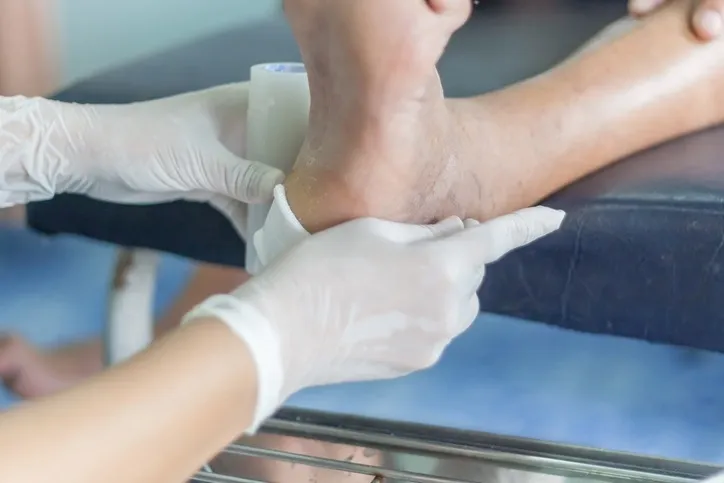
Researchers at Karolinska Institutet have identified a circular RNA in mitochondria that plays an important role in the healing of chronic wounds. The study is published in Advanced Science.
Diabetic foot ulcers are slow‑healing and increase the risk of infections and amputation. In the new study, researchers at Karolinska Institutet show that a mitochondrial circular RNA, circMTRNR2, is reduced in tissue from patients with long‑standing diabetic foot ulcers. The molecule appears to support the skin’s reparative capacity by protecting the cells’ energy metabolism against harmful stress.
Affects fibroblasts in the skin
The researchers analysed skin samples from patients with non‑healing wounds as well as from healthy donors. They also used an experimental wound model system in both human skin and mice. The results showed that when circMTRNR2 decreased, fibroblasts’ ability to grow, move, and build new tissue was impaired. Fibroblasts are a type of skin cell that are central to wound healing.

“Our results suggest that this RNA molecule acts as a protective factor for the cells’ mitochondria by stabilising an antioxidant that counteracts harmful stress,” says Jennifer Geara, doctoral student in Ning Xu Landén's research group at the Department of Medicine, Solna.
When circMTRNR2 is absent, cellular stress increases and the mitochondria are damaged, which slows down the healing of the wound.
Potential target for future treatments
In both models of human wound tissue and animal models, the researchers observed that the healing process was slower when the amount of circMTRNR2 was reduced and faster when it was increased. According to the researchers, the molecule could therefore become a future target for treating chronic wounds, but more research is needed.
“The next step is to investigate how circMTRNR2 can be delivered directly to wound tissue and whether this can improve healing in patients with long‑standing wounds,” says Jennifer Geara.
The study was conducted in collaboration with Karolinska University Hospital. It was funded by, among others, the Swedish Research Council, Ragnar Söderberg Foundation, the Swedish Skin Foundation (Hudfonden), Ming Wai Lau Centre for Reparative Medicine, LEO Foundation, the Swedish Cancer Society, and the Åke Wiberg Foundation. Another important contribution was the funding of Guanglin Niu's post-doctoral fellowship from the Strategic Research Programme in Diabetes.
Publication
"Mitochondrial CircRNA CircMT-RNR2 Safeguards Antioxidant Defense to Support Fibroblast Functions in Wound Repair", Guanglin Niu, Jennifer Geara, Yongjian Chen, Lihua Luo, Yanwei Xiao, Zhuang Liu, Margaux Gaborieau, Ling Pan, Edmund Loh, Dongqing Li, Pehr Sommar, Aoxue Wang, Xiaowei Zheng, Ning Xu Landén. Advanced Science, online 8 February, 2026, doi: 10.1002/advs.202517141