
Half-Time Review Reveals New Insights into Medical Oxygen Access in Nigeria
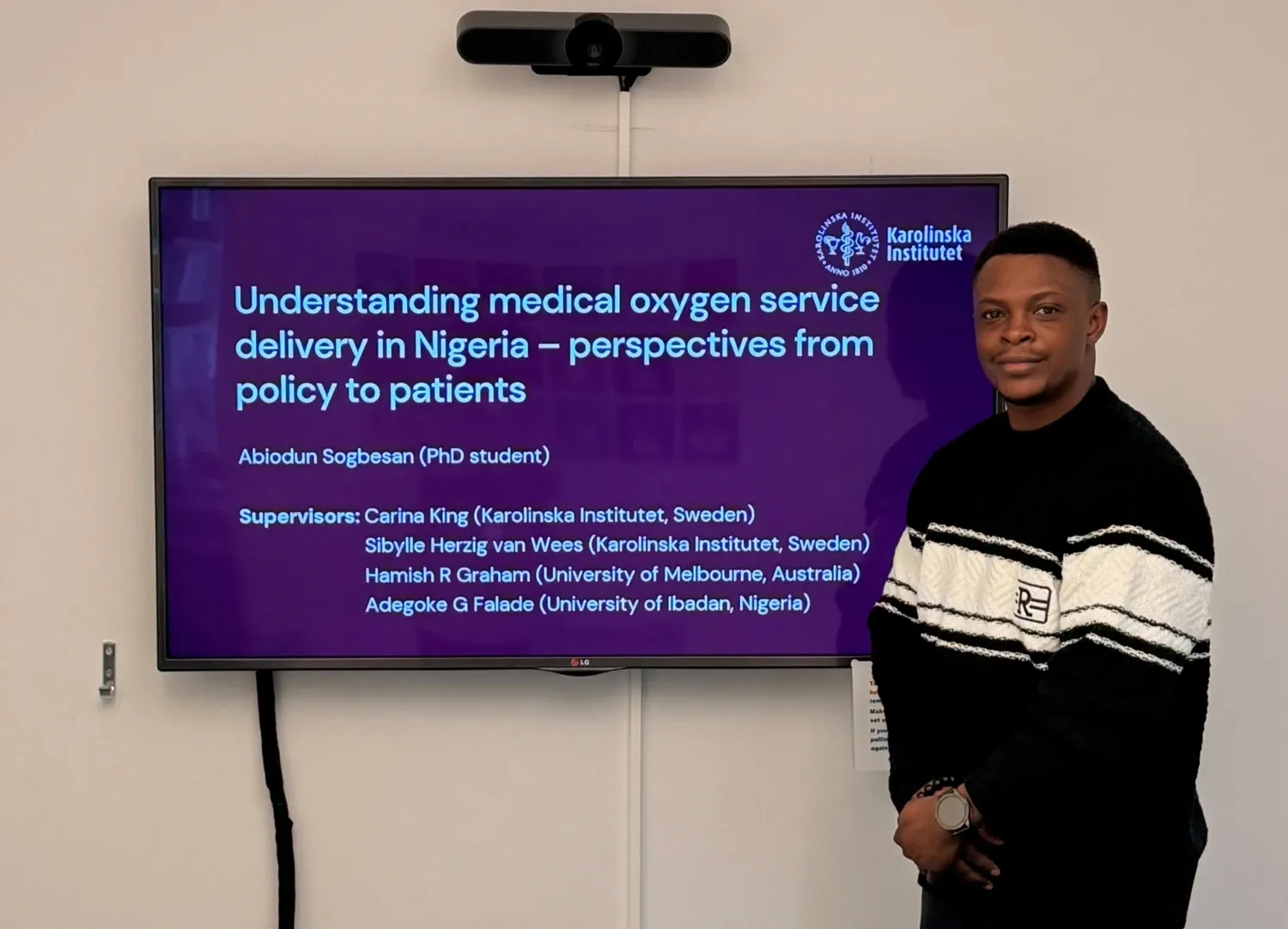
As Abiodun Sogbesan reaches the halfway point of his doctoral journey, his research is already shedding new light on how medical oxygen services function across Nigeria’s health system. By examining policy implementation, facility readiness, and the everyday adaptations made by healthcare workers and families, the project is uncovering critical insights that could help improve equitable and sustainable access to lifesaving oxygen for children.
Congratulations on passing your half-time review on May 11th. Could you give a short overview of your PhD project?
My PhD focuses on generating evidence to improve policy implementation and practice in medical oxygen services in Nigeria by deepening understanding of how oxygen services are delivered across national/subnational, facility, and individual levels. Drawing on perspectives from policymakers, healthcare providers and managers, patients, and caregivers, the research explores how subnational oxygen coordination mechanisms are operationalised, provides a more comprehensive assessment of facility oxygen service readiness, oxygen coverage, and the quality of oxygen-related care, and examines the roles of non-clinical healthcare workers and parents in supporting oxygen-related care for acutely ill children.

How do you feel your progress has been so far?
I think the progress I have made so far has been very encouraging. I did not fully realise how much had been accomplished until my half-time seminar and the feedback from the committee members. Reflecting on where the project currently stands, I am close to completing data collection, preparing to submit a manuscript for one sub-study, and conducting preliminary analyses for two additional sub-studies. I think that during the PhD journey, one can become so focused on putting the remaining pieces together that it is easy to overlook how far one has already progressed, given the often non-linear nature of the process.
“One key insight from our assessment of medical oxygen service readiness was that facility-level availability often masks ward-level variation”
What insights or findings have emerged so far?
One key insight from our assessment of medical oxygen service readiness for children in Nigerian public secondary and tertiary hospitals — the first major study to implement the Lancet Global Health Commission on Medical Oxygen Security facility service readiness framework — was that facility-level availability often masks ward-level variation. Another important finding was that oxygen systems operate within a complex adaptive ecosystem. Across facilities, staff, including biomedical engineers, often compensate for system and structural weaknesses through informal adaptive practices such as task-shifting, workarounds, and reactive redistribution of oxygen. While these adaptations help sustain care, they can also mask persistent system fragilities. The implications of these findings for policy and practice are that interventions sensitive to existing facility-level adaptations may better address inequities and improve sustainable access to medical oxygen.
Abiodun Sogbesan successfully passed his half-time review on 11 May 2026.
Title: Understanding medical oxygen service delivery in Nigeria - Perspectives from policy to patients
The half-time committee consisted of:
Martin Gerdin Wärnberg, Docent, GPH, Karolinska Institutet
Björn af Ugglas, LIME, Karolinska Institutet
Funmilola OlaOlorun, Senior Lecturer, College of Medicine, University of Ibadan, Nigeria
Main supervisor is Docent Carina King, GPH, Karolinska Institutet
Co-supervisors are:
Sibylle Herzig van Wees, Docent, GPH, Karolinska Institutet
Hamish Graham, Associate Professor, Murdoch Children’s Research Institute, Melbourne, Australia
Adegoke G Falade, Professor, Oxygen for Life Initiative, Ibadan, Nigeria