

2026 IADR/AADOCR William J. Gies Award Recipients Announced
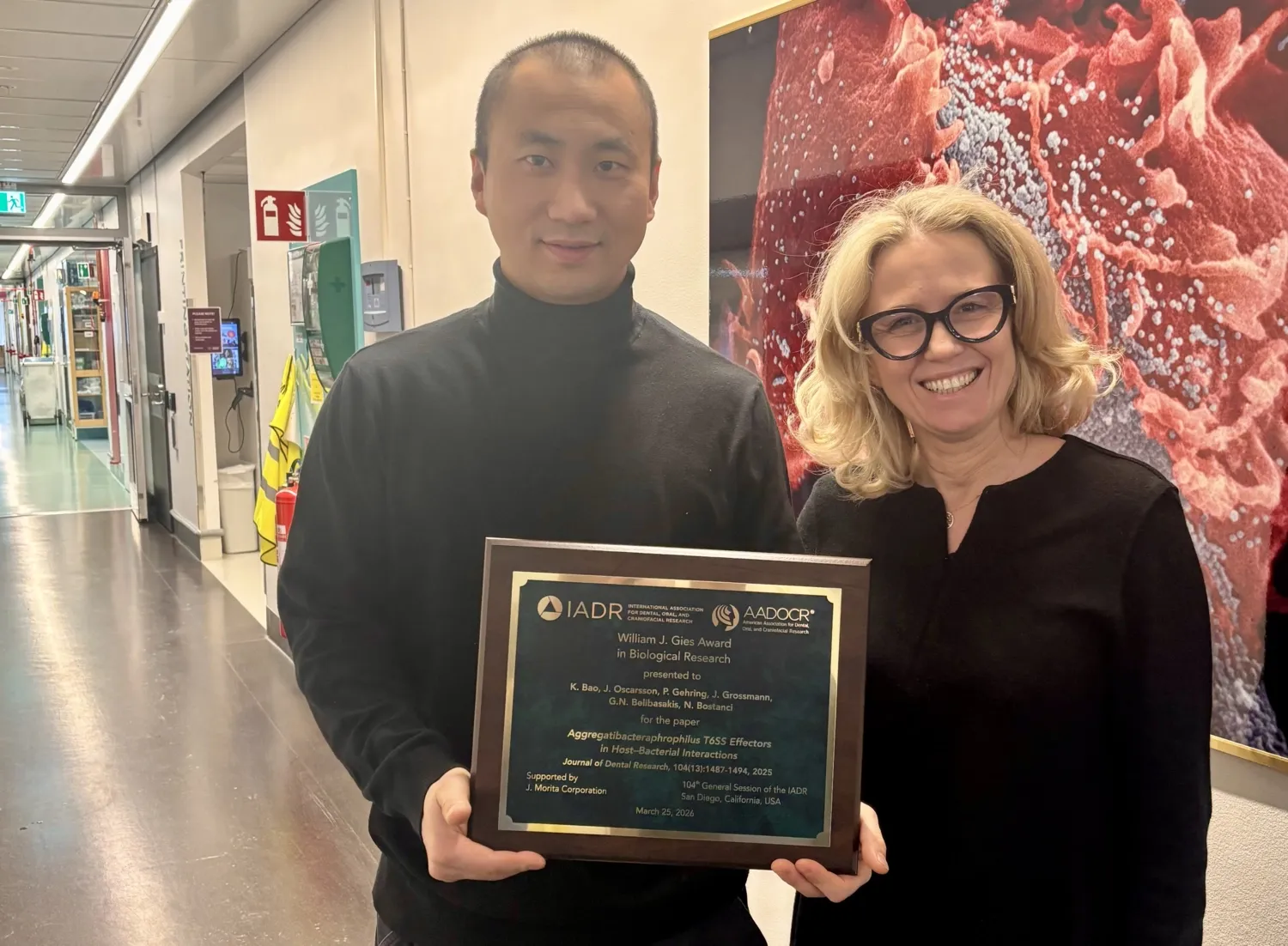
We would like to extend our warm congratulations to Kai Bao and colleagues, who have been awarded the IADR/AADOCR William J. Gies Award for the best article published in the Journal of Dental Research in 2025 within the category of biological research.
Can “Good” Bacteria Keep Harmful Oral Microbes in Check and Prevent Severe Periodontal Inflammation?
Oral bacteria rarely exist in isolation and they play an important role in maintaining oral health but also in contributing to disease. Within the crowded environment of a dental biofilm (dental plaque), bacteria compete intensely for limited space and nutrients. To survive, some have evolved antagonistic strategies that allow them to suppress or eliminate their rivals. In their awarded study, Bao and colleagues asked how such microbial interactions influence oral health.
Aggressive periodontitis, formerly called early onset periodontitis, can occur in young individuals with rapid loss of tooth‑supporting tissues and eventually loss of the tooth itself. In these cases, the amounts and proportions of the bacterium Aggregatibacter actinomycetemcomitans are often elevated in the associated dental biofilm which triggers the disease. Rather than focusing solely on eliminating this harmful bacterium, the group explored how another closely related oral species associated with periodontal health, Aggregatibacter aphrophilus, might keep A. actinomyctetemcomitans under control.
In their previous and current work, they found that the protective bacterium carries a kind of molecular “syringe” (called a type VI secretion system, abbreviated T6SS). This microbial weapon allows A. aphrophilus to inject proteins into nearby bacteria, including A. actinomyctetemcomitans, to kill or disrupt them. However, this effect is abolished when the bacterium is mutated in a way that inactivates its syringe-like apparatus. Notably, no harmful effects on human cells have been observed, suggesting that A. aphrophilus may represent a potentially beneficial commensal with relevance for periodontal health.
In future work, the team aims to better understand why different bacteria occupy specific niches in the mouth and how the growth of health‑promoting microbes can be encouraged. Ultimately, the goal is to harness bacterially mediated antagonism as a potential antimicrobial strategy to help prevent periodontitis and possibly support treatment in affected individuals, while ensuring that any such interventions remain safe for host tissues. This work was supported by funding from the Swedish Research Council.
Bao, K., Oscarsson, J., Gehring, P., Grossmann, J., Belibasakis, G. N., & Bostanci, N. (2025). Aggregatibacter aphrophilus T6SS Effectors in Host-Bacterial Interactions. Journal of Dental Research, 220345251337745. https://journals.sagepub.com/doi/10.1177/00220345251337745